
Removable Battery: The era of removable-battery smartphones is making a comeback in this country..
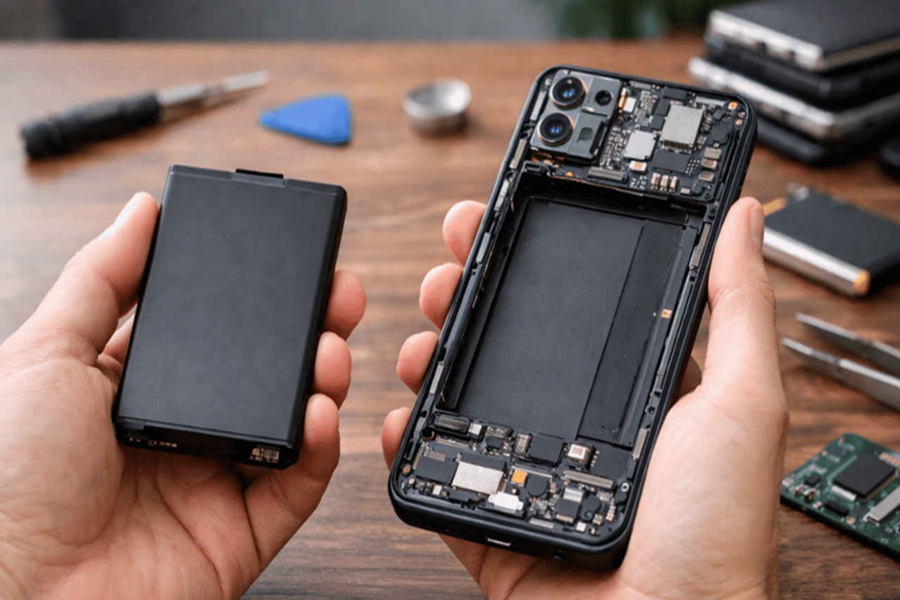
Do you remember the old days when, if our phone froze or the battery failed, we would simply pop open the back cover and replace the battery ourselves? In the world of smartphones, that bygone era is making a comeback. The European Union (EU) has implemented new and stringent regulations regarding the manufacturing of smartphones. The primary objective of these rules is to ensure that your smartphone lasts longer and can be repaired with ease.
These regulations—set to take effect between June 2025 and February 2027—are poised to bring about a massive transformation within the smartphone industry. Manufacturers will now be required to produce phones featuring batteries that do not degrade prematurely, parts that remain available for years, and designs that can be easily opened and repaired without the need for specialized machinery. By 2027, the landscape will have shifted to a point where users can replace their phone batteries themselves, right from the comfort of their own homes.
**What Do the New EU Rules Stipulate?**
According to the EU's new regulations, smartphone batteries must now be designed in such a way that any user can easily remove and replace them personally, without requiring specialized technical expertise or complex tools. Given the sealed, unibody designs prevalent today, this represents a revolutionary shift. Manufacturers have been granted until February 18, 2027, to fully implement these changes. Under these rules, companies must not only facilitate battery replacement using standard tools but also ensure that replacement batteries remain commercially available for several years following the phone's initial launch.
Furthermore, companies are required to provide clear instructions on how to replace batteries and how to dispose of them safely; for the sake of transparency, they must also affix labels such as a "Digital Battery Passport." These regulations are not limited solely to smartphones; they apply equally to tablets and other portable electronic devices.
**Phase One Underway: Major Changes Expected by February 2027**
The first phase of these regulations officially commenced in June 2025. Consequently, all phones sold within the EU must now meet rigorous durability standards. Brands will be required to make spare parts available for years to come and cannot prevent any third-party or local repair services from performing repairs.
The most significant change will take effect starting in February 2027. From that point onward, smartphones must be designed in such a way that users can replace the phone's battery themselves—using only simple tools—without having to visit a service center. People often purchase a new phone simply because the battery stops holding a charge, even though the rest of the device remains in perfect working order. The straightforward implication of these regulations is to extend the lifespan of your existing smartphone.
Why is this regulation being introduced?
The primary and fundamental objective behind the European Union's introduction of this regulation is to curb the mounting piles of electronic waste (e-waste) and to extend the operational life of electronic devices. It is frequently observed that people discard their valuable smartphones solely because the battery has degraded, even when the rest of the phone—including its hardware—remains fully functional.
Through this provision for easy battery replacement, the EU aims to mitigate environmental damage and foster a culture of recycling. This initiative will not only lead to a reduction in electronic waste but will also enable older phones to remain in use for longer periods, thereby facilitating the development of a "circular economy." Furthermore, a crucial aspect of this regulation is that it will simplify the process of recovering and reusing valuable materials—such as lithium and cobalt—that are utilized in battery manufacturing. This, in turn, will alleviate the pressure on natural resources.
Key Requirements Mobile Companies Must Adhere To
Mobile companies will now be required to comply with a series of critical and stringent regulations that will fundamentally transform the entire lifecycle of a phone, from its manufacturing to its repair. Under this new regulatory framework, the most significant change will be evident in the design of the phones themselves. Devices will now be engineered to allow for easy disassembly and servicing. Companies must ensure that average users can replace their phone batteries independently, utilizing only simple, readily available tools. Furthermore, the quality of the battery must also be improved so that its capacity remains at least 80% even after undergoing 800 full charge cycles.
Is this rule applicable only to Europe?
Although this rule originates from the European Union (EU), it will impact the global mobile market as a whole. No global company (such as Apple or Samsung) would want to manufacture phones with separate designs—one for Europe and another for the rest of the world—as doing so would increase both their costs and their workload. Consequently, European regulations often end up becoming global standards. The most recent example of this is the USB-C port. When the EU mandated the use of Type-C cables, Apple was compelled to launch the iPhone 15 series globally with a Type-C port.
Disclaimer: This content has been sourced and edited from Amar Ujala. While we have made modifications for clarity and presentation, the original content belongs to its respective authors and website. We do not claim ownership of the content.
