
OTT Boom Disrupts Traditional TV Business: Why Major Broadcasters Like JioStar, Zee and NDTV Shut Down Channels
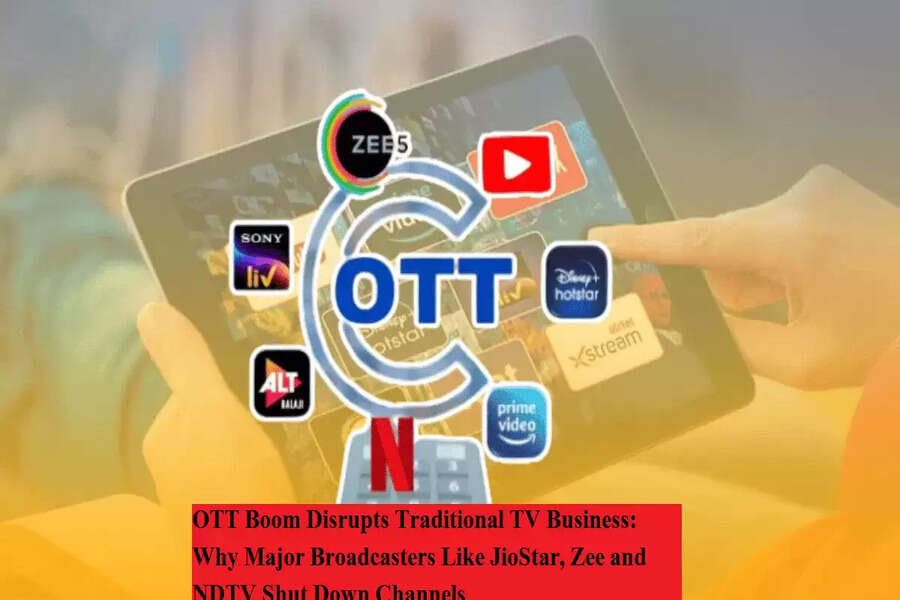
India’s television industry is going through one of its biggest transitions in decades. The rapid rise of OTT platforms and digital viewing habits has significantly shaken the traditional TV business. As audiences increasingly prefer watching content on smartphones, smart TVs and streaming apps, conventional television channels are struggling to stay relevant. The impact of this shift is now clearly visible: nearly 50 TV channels have surrendered their licenses in the last three years, according to data from the Ministry of Information and Broadcasting.
This trend highlights the growing pressure on the traditional broadcasting ecosystem, where rising operational costs, falling advertising revenues and changing viewer preferences are forcing even large media houses to rethink their strategies.
Around 50 TV Channels Shut Down in Three Years
Official figures reveal that close to 50 television channels in India have either shut down operations or returned their licenses over the past three years. What makes this trend significant is that it does not involve only smaller players. Several well-known broadcasters have taken similar steps, including JioStar, Zee Entertainment Enterprises, NDTV, ABP Network, TV Today Network, and Eenadu Television.
These broadcasters have cited different reasons for shutting specific channels, but the underlying challenges remain largely the same—declining viewership on linear TV and increasing competition from digital platforms.
Sony Network Also Reduced Channel Operations
Culver Max Entertainment, which operates Sony Pictures Networks India, has also scaled back its television presence. The company surrendered 26 downlinking permissions after receiving combined approval for both uplinking and downlinking for certain channels. Industry experts say such decisions reflect broader strategic realignments within media companies, aimed at reducing duplication, controlling losses and adapting to a fast-changing content market.
Running a TV channel today has become increasingly expensive, while returns have continued to shrink. In this scenario, many broadcasters feel that maintaining multiple niche or regional channels is no longer financially viable.
Viewers Rapidly Shifting to OTT Platforms
The most significant factor behind this disruption is the massive shift in audience behavior. India’s pay-TV sector has been under sustained pressure as affluent and middle-class households move toward OTT platforms, which offer flexible viewing, personalized content and competitive pricing. On the other hand, lower-income households are increasingly relying on free-to-air services like DD Free Dish.
Industry data reflects this shift clearly. In FY19, India had around 72 million pay DTH subscribers. By FY24, this number had fallen to about 62 million, and current estimates suggest it may drop below 51 million in the ongoing financial year. This steady decline has directly impacted subscription revenues for broadcasters.
Advertising Revenue Decline Adds to the Pressure
Advertising trends are also working against traditional television. While the overall advertising market continues to grow, a larger share of ad spending is moving toward digital platforms. According to WPP estimates, TV advertising revenue could decline by around 1.5 percent in 2025.
Digital platforms offer advertisers better targeting, real-time analytics and measurable returns, making them more attractive than conventional TV ads. As a result, broadcasters are facing shrinking ad budgets even as content and distribution costs rise.
Major Channels That Have Shut Down
Several prominent channels have gone off air in recent years. JioStar surrendered licenses for channels such as Colors Odia, MTV Beats, VH1 and Comedy Central. Zee Entertainment shut down Zee Sea, while Enter10 Media exited Dangal HD and Dangal Oriya after a strategic review.
Similarly, ABP Network closed ABP News HD, and NDTV returned the license for its proposed NDTV Gujarati channel before launch. These closures underline how even established brands are reassessing their television footprint.
A Structural Shift in the TV Industry
Industry bodies believe this downturn is not temporary but a result of structural changes driven by technology and media convergence. Audience preferences are evolving rapidly, and regulatory as well as operational challenges are adding to broadcasters’ difficulties. Content consumption is becoming more on-demand, interactive and mobile-first—areas where traditional TV struggles to compete.
What Lies Ahead for Television?
The Indian television sector is likely to witness further consolidation and transformation in the coming years. Broadcasters may focus more on fewer, stronger channels while increasing investments in digital platforms and hybrid models. While TV is unlikely to disappear entirely, its role and scale are clearly changing.
In the age of OTT dominance, traditional television must reinvent itself to survive—or risk being left behind in a rapidly evolving media landscape.
