
Nvidia Plans Home-Based Mini Data Centers to Power AI Using Unused Household Energy..
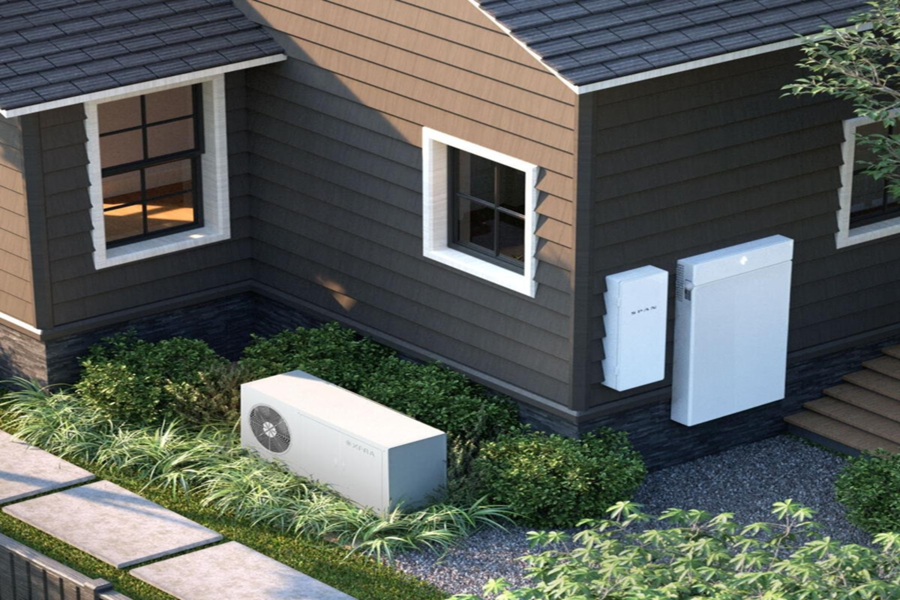
The use of Artificial Intelligence (AI) is expanding rapidly, and powering it requires vast amounts of electricity and massive data centers. To address this challenge, tech giant Nvidia has devised a highly unique and ingenious solution. Instead of constructing colossal data centers, companies are now preparing to utilize the empty walls within your home to serve as 'mini data centers.' Let's explore what this technology entails and how it will function.
**What is this new project?**
NVIDIA has partnered with the California-based startup Span.io and the renowned homebuilder PulteGroup. Under this partnership, a compact data center unit will be installed directly onto the walls of new homes. These units have been designated the name 'XFRA.' Testing for this initiative is scheduled to commence in the third quarter (Q3) of 2026.
**How will it work, and why was it needed?**
As the world of AI expands at an accelerating pace, the demand for correspondingly larger data centers to power it grows as well. However, the challenge lies in the fact that constructing large-scale data centers requires vast tracts of land, numerous government permits, and a massive supply of electricity—factors that have become significant hurdles in the modern era. It is precisely to resolve this issue that Nvidia and its partners have discovered this novel approach.
Studies indicate that, on average, households utilize only 40% of their total available electrical capacity, leaving the remaining 60% entirely unused. The company's core concept revolves around harnessing this 'unused' electricity. These mini data centers (XFRA) will be powered by tapping into the very surplus electricity available within homes.
When thousands of these units—installed across numerous homes—are interconnected via an internet network, they will collectively form a vast and powerful AI network—one that rivals the capabilities of a traditional, large-scale data center. In essence, this means that the global AI network could be powered by the surplus electricity within your own home, without the need to acquire or occupy any new land.
**What will the XFRA unit contain?** Although this wall-mounted XFRA box may appear small at first glance, it is, in reality, no ordinary device—it is an incredibly powerful machine. The sheer magnitude of its power can be gauged by the fact that a single unit houses a high-end graphics system comprising 16 Nvidia RTX Pro 6000 Blackwell GPUs.
But that’s not all; to drive this setup, it utilizes four AMD EPYC CPUs, and to ensure seamless multitasking, it is equipped with a massive 3TB of RAM. Simply put, this is a compact "supercomputer" hanging on your home's wall, engineered specifically to power the world of AI.
**How will homeowners benefit from this?**
If a homeowner grants permission to install this hardware on their wall, they stand to gain not just one, but several significant financial and technical advantages. The most substantial benefit comes in the form of electricity bill savings, as the company will offer homeowners substantial discounts in exchange for utilizing their surplus electrical capacity. Additionally, the home will gain access to a free battery backup facility, ensuring that operations continue uninterrupted even in the event of a power outage.
For those who are environmentally conscious, there is also an option to integrate solar panels into the system. As for safety and the protection of household appliances, there is absolutely no need for concern. Span’s "Smart Panel" will continuously monitor the electrical load around the clock, ensuring that the home's main power line never suffers from an overload and that the entire system remains completely secure.
**What is each company's role?**
To transform this revolutionary project into reality, the three participating companies have allocated responsibilities based on their respective areas of expertise. In this collaboration, Nvidia serves as the "brain" of the entire network, providing its world-leading GPU technology. Meanwhile, Span is responsible for developing the smart infrastructure and smart electrical panels required to operate this hardware, thereby ensuring the efficient and proper distribution of electricity. PulteGroup has taken on the responsibility of bringing this entire initiative to fruition, conducting real-time testing of these systems in the new homes it is currently building across select cities. It is through the collaboration of these three entities that the transformation of an ordinary home into a high-tech data center has become possible.
Disclaimer: This content has been sourced and edited from Amar Ujala. While we have made modifications for clarity and presentation, the original content belongs to its respective authors and website. We do not claim ownership of the content.
