
Now, this typing system will detect online fraud: a person's identity will be verified based on the speed of their fingers on the keyboard.
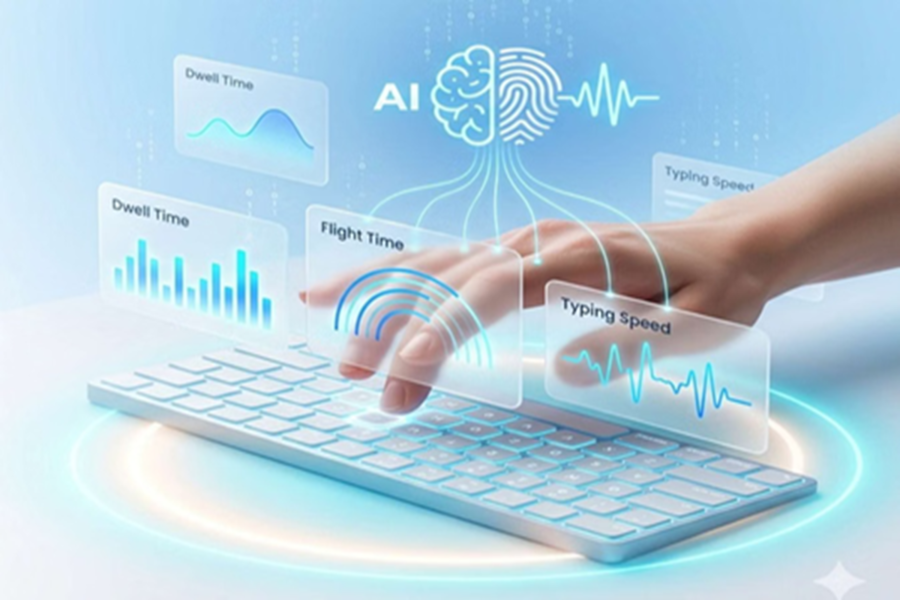
AI Typing Detection: From academics to employment and banking, more than half of our work today has shifted online. However, alongside this digital convenience comes a major headache: how can we ensure that the candidate sitting in front of the screen during an online test or exam is, in fact, the same person who originally filled out the application form? Until now, efforts to prevent such cheating have relied solely on cameras, microphones, and screen monitoring. But now, the world of online security is poised to change forever.
What are Keystroke Dynamics?
Keystroke Dynamics is an AI and machine learning technology that records and analyzes an individual's typing patterns. This technology focuses not on the words themselves, but rather on the habits associated with typing. It captures various human behaviors, such as how long a person holds down a specific key; the time elapsed between pressing one key and the next; typing speed; error frequency; the number of times the backspace key is pressed; and the extent of any pauses or hesitations during typing. By aggregating all this data, the AI constructs a unique digital identity for the individual.
Every Person's Typing Style is Unique
Just as every individual possesses a distinct voice, signature, and set of fingerprints, their typing style is equally unique. Even if 100 different people were to type the same sentence, the underlying patterns generated by each of them would still be distinct.
To put it more simply: some people type very rapidly, while others type slowly. Some individuals make frequent use of the backspace key, whereas others type continuously without interruption. By recognizing these subtle differences, the AI is able to accurately identify the individual.
How Does It Detect Cheating in Online Exams?
In the context of online examinations, instances of having a proxy take the test, copy-pasting answers, or having a different person sit in mid-way are frequently reported. Keystroke Dynamics can prove to be an invaluable tool in preventing such occurrences. The system initially records the student's unique typing style at the very beginning of the session and subsequently monitors that specific pattern continuously throughout the entire duration of the exam. Furthermore, if the typing speed, error patterns, or typing rhythm suddenly shift mid-session, the system immediately issues an alert. This allows it to detect whether a different individual might be composing the response.
**How Does Machine Learning Work?**
Machine learning plays a pivotal role in the technology underpinning this process. The AI first learns an individual's typing habits and subsequently creates a digital profile for them. This profile is then used to cross-reference live typing activity against historical data. If any anomalies or unusual changes are detected, the system flags them as suspicious. Moreover, the AI continuously adapts and learns new typing habits over time.
**What Data Is Recorded?**
Keystroke Dynamics records several key parameters, as outlined above:
**Dwell Time:** The duration for which an individual holds down a specific key.
**Flight Time:** The time elapsed between releasing one key and pressing the next.
**Typing Speed:** The rate or pace of typing.
**Error Rate:** The frequency of errors and backspace usage.
**Copy-Paste Pattern:** The complete history of copy-paste activities.
By combining all these data points, the AI constructs a unique digital identity for the individual.
**Companies Are Now Adopting It**
Significantly, this technology is no longer confined solely to laboratories or research environments. Many of the world's leading corporations, online universities, and digital platforms have now begun to implement Keystroke Dynamics. During online examinations and job interviews, this technology verifies whether the person taking the test is, in fact, the genuine candidate or an imposter. Meanwhile, banks and financial institutions are utilizing users' typing styles to detect fraudulent and suspicious activities. This AI-driven system is rapidly becoming an integral component of digital security and online identity verification protocols.
**Is This Technology Completely Flawless?**
Although this technology is considered highly advanced, it cannot be guaranteed to be absolutely perfect. Typing patterns can sometimes deviate due to factors such as fatigue, stress, illness, or simply typing in haste. For this reason, companies typically do not rely on this technology in isolation; instead, they integrate it as part of a broader security framework. It is typically combined with techniques such as webcam monitoring, facial recognition, audio monitoring, browser locking, and plagiarism detection. By integrating all of these elements, a robust digital security system is established.
Usage Set to Increase Further in the Future
With the rise of online education, 'work from home' arrangements, and digital testing, the use of AI technologies—such as keystroke dynamics—is likely to accelerate significantly in the times to come. This technology will not remain limited merely to detecting cheating; rather, it could also evolve into a major component of digital identity and cybersecurity.
Disclaimer: This content has been sourced and edited from Amar Ujala. While we have made modifications for clarity and presentation, the original content belongs to its respective authors and website. We do not claim ownership of the content.
