
Live TV on your phone even without the internet: Prasar Bharati is launching the D2M service—what is it and how will it work?
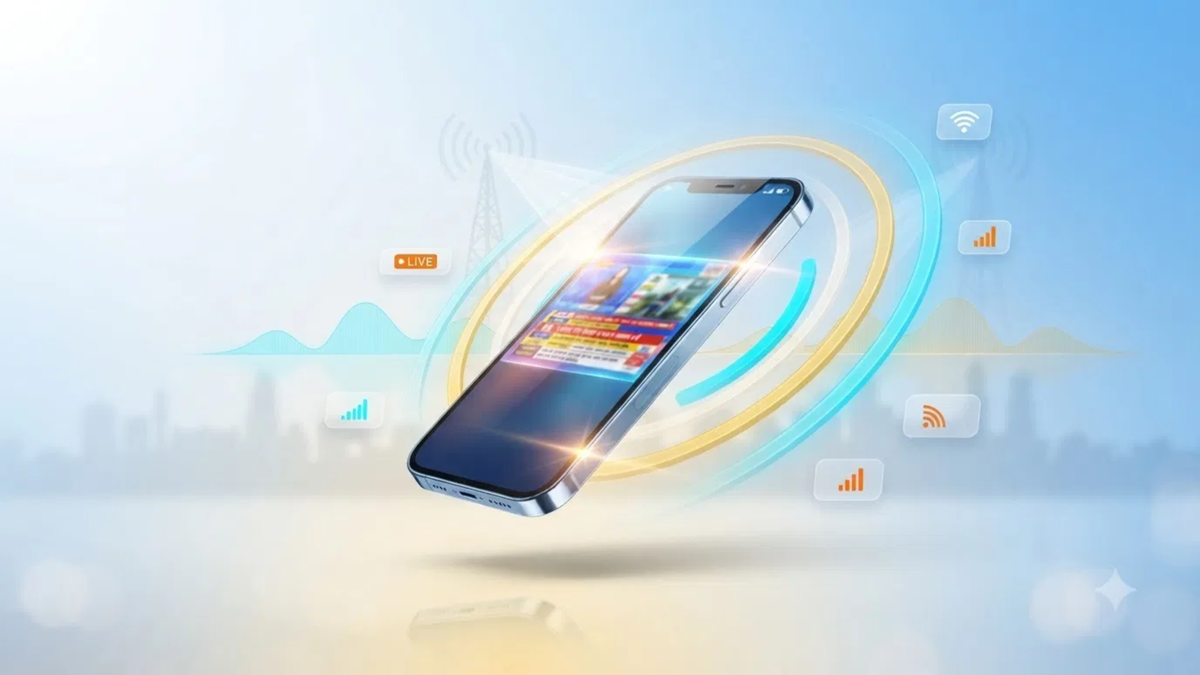
Will you soon be able to watch live TV on your phone without an internet or mobile network connection? Preparations to commercially launch Direct-to-Mobile (D2M) broadcasting in India are gaining momentum. According to reports, the public broadcaster Prasar Bharati may issue a Request for Proposal (RFP) next month for the commercial rollout of D2M. This move follows a government review of the technology validation tests for equipment developed by Tejas Networks. However, the exact timeline remains unclear.
What is Direct-to-Mobile (D2M) technology?
D2M is a broadcasting technology that does not require cellular networks—such as call or internet connections—to deliver content to mobile phones. It functions somewhat like FM radio, where a receiver within the device captures signals transmitted via radio frequencies.
Once commercially rolled out, this technology could enable the streaming of live TV, news, sports, and other multimedia content on smartphones. It could prove particularly useful in areas with poor internet connectivity.
Watching content via D2M does not consume mobile data. This can help users save on data plans and reduce the load on mobile data networks. Additionally, D2M can be utilized to disseminate emergency alerts and critical public information. The D2M initiative by Prasar Bharati and IIT Kanpur also incorporates use cases such as education and emergency response.
Preparations for commercial rollout intensify.
According to reports, Prasar Bharati is preparing to issue an RFP for the commercial rollout of D2M. Reports indicate that the equipment developed by Tejas Networks has successfully cleared recent technology validation tests, accelerating the process toward a commercial launch. The RFP process could determine the next steps regarding the large-scale deployment of D2M, as well as the necessary technology and commercial partnerships. However, the exact date for the RFP's release and the final timeline for the launch of commercial services remain unclear.
**Trials conducted in over 19 cities**
Trials and proof-of-concept demonstrations for D2M technology have been underway for the past few years. Prasar Bharati, IIT Kanpur, and Saankhya Labs (now part of Tejas Networks) have conducted trials in more than 19 cities. These trials tested the technology's capabilities using various broadcast infrastructures.
Earlier proof-of-concept demonstrations in Delhi and Bengaluru have already proven the technology's viability by successfully transmitting multimedia content directly to mobile devices. According to Prasar Bharati, a technical roadmap for D2M has also been developed in collaboration with IIT Kanpur.
**What were the findings regarding security and interference?**
A major concern regarding D2M was whether broadcast signals might interfere with existing telecom services or cause phones to overheat. Addressing this, Prasar Bharati, in partnership with IIT Kanpur, conducted tests on D2M technology concerning interference and mobile device temperatures within the 470–582 MHz frequency range. Prasar Bharati released the report on these tests in November 2025. In May 2026, the organization also released test reports regarding the impact of D2M transmission in the 470–582 MHz band on IMT (mobile) services.
**Concerns raised by telecom companies**
Private telecom operators have also expressed concerns regarding D2M. Their concern is that if users start consuming large volumes of video and other content via broadcast networks instead of the internet, it could impact their data and content-delivery businesses.
For this reason, the commercial rollout of D2M will hinge not only on the technology itself but also on business models and public-private partnerships. An EY report also recommends a public-private partnership model and a long-term commercial framework for D2M.
**D2M Won't Work on Every Phone**
A major question regarding D2M is whether all existing smartphones will support this technology. The answer, for now, is no. Most current mobile devices lack the hardware required for D2M. Implementation may necessitate specific technical components—such as a dedicated baseband processing unit, antenna, low-noise amplifiers, baseband filters, and receivers—compliant with the ATSC 3.0 standard. In other words, it will not be possible to make every existing phone D2M-compatible merely through a software update; the device must also possess the necessary hardware support.
**Infrastructure Required for Large-Scale Rollout**
Implementing D2M on a large scale will require upgrading existing broadcast and telecom infrastructure. A dense network of terrestrial towers will be essential for large-scale transmission. Consequently, the commercial rollout will not be limited to simply issuing RFPs or adding receivers to mobile devices; it will require the simultaneous development of broadcast networks, device support, and content delivery systems.
Disclaimer: This content has been sourced and edited from Amar Ujala. While we modified it for clarity and presentation, the original content belongs to its respective authors and website. We do not claim ownership of the content.
