
If a cooler runs for 14 to 15 hours a day, how much will the electricity bill be? Here is the complete calculation..
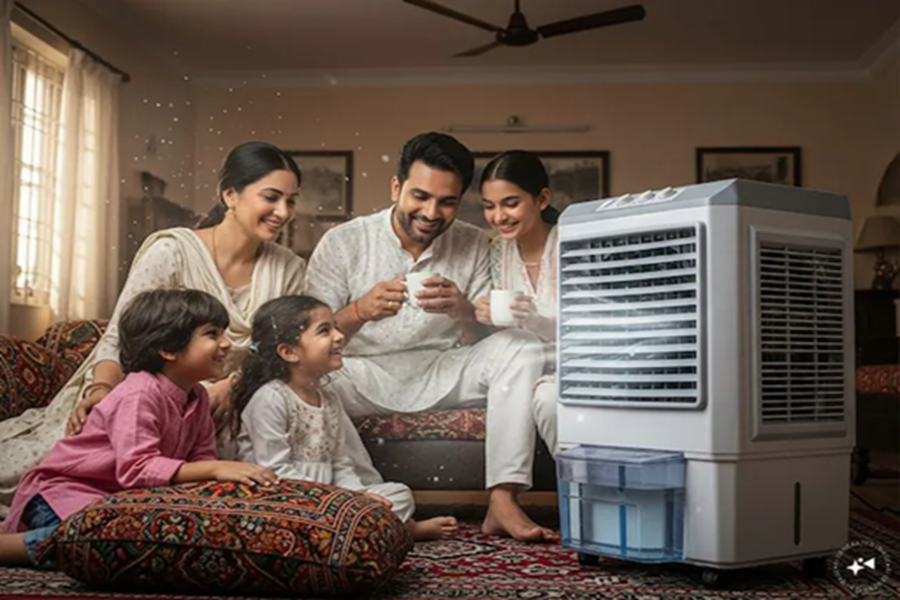
As soon as the summer season begins, the demand for air coolers in households surges. Intense sunlight, scorching heatwaves, and humid nights compel people to run their coolers around the clock—day and night. In many families, a cooler runs continuously from morning until late at night, amounting to 14 to 15 hours a day. However, when the electricity bill arrives, it can be quite a shock. A question that crosses everyone's mind is: if a cooler is run for 14–15 hours a day, how high will the electricity bill be? Let's break this down in simple terms.
How much electricity does a cooler consume?
In India, the power rating for commonly used "desert coolers" (the large, floor-standing or trolley-mounted models) typically ranges from 180 to 250 watts. Smaller "personal coolers" generally consume between 100 and 150 watts, whereas larger desert coolers draw an average of 200 to 250 watts of power. Let's do the math (assuming an average consumption of 220 watts): Hourly consumption: 220 watts = 0.22 units (kWh).
Over 14 hours: 14 × 0.22 = 3.08 units per day.
Over 15 hours: 15 × 0.22 = 3.30 units per day.
Now, let's look at the monthly consumption (over 30 days):
Running for 14 hours daily: 3.08 × 30 = 92.4 units.
Running for 15 hours daily: 3.30 × 30 = 99 units.
How much will the electricity bill amount to?
In 2026, the average rate for domestic electricity in India ranges from ₹5 to ₹8 per unit (due to the tiered "slab" system). In many states, the first 200 units of consumption are charged at a lower rate, after which the rate increases. Let's understand this with an example (assuming an average rate of ₹6.50 per unit):
Running it for 14 hours daily: 92 units × ₹6.50 = ₹600
Running it for 15 hours daily: 99 units × ₹6.50 = ₹640–₹650
If your total household electricity consumption reaches the 300–400 unit range (including the cooler, refrigerator, and other appliances), moving into a higher tariff slab could push the average rate up to ₹7–₹8 per unit. In such a scenario, the cooler alone could add anywhere from ₹700 to ₹800 to your monthly bill.
Note: If your cooler is old, or if you run the fan at a high speed, power consumption can reach up to 250–300 watts, which will further increase your electricity bill.
Newer, energy-efficient coolers equipped with BLDC motors consume only 100–150 watts, resulting in significantly lower electricity bills.
How to Reduce Your Bill?
Get it serviced: Dirty filters and clogged cooling pads cause the cooler to consume more electricity. Ensure you get it serviced before the start of every season.
Choose the Right Speed: Run the cooler on medium speed instead of high speed. You get nearly the same level of cooling while saving electricity.
Monitor Water Levels: Keeping the water tank filled to the brim places an unnecessary load on the motor.
Use a Stabilizer: Voltage fluctuations lead to increased power consumption.
Reduce Usage at Night: At night, consider running the cooler in conjunction with a standard fan, or set a timer to switch it off automatically.
Buy Energy-Efficient Models: Opt for 5-star rated or BLDC-motor coolers; they offer substantial savings in the long run.
While a cooler is essential during the summer heat, a little caution can help keep your electricity bill under control. If you own a 200-watt cooler and run it for 15 hours a day, the additional monthly cost should typically hover around ₹600–₹800. If your bill exceeds this amount, the first step should be to get your cooler serviced and inspected. Run your cooler smartly this summer to enjoy effective cooling while keeping your electricity bill in check.
Disclaimer: This content has been sourced and edited from News18 Hindi. While we have made modifications for clarity and presentation, the original content belongs to its respective authors and website. We do not claim ownership of the content.
