
How Does an Induction Cooktop Work? If You Are Using One for the First Time, Keep These Points in Mind...
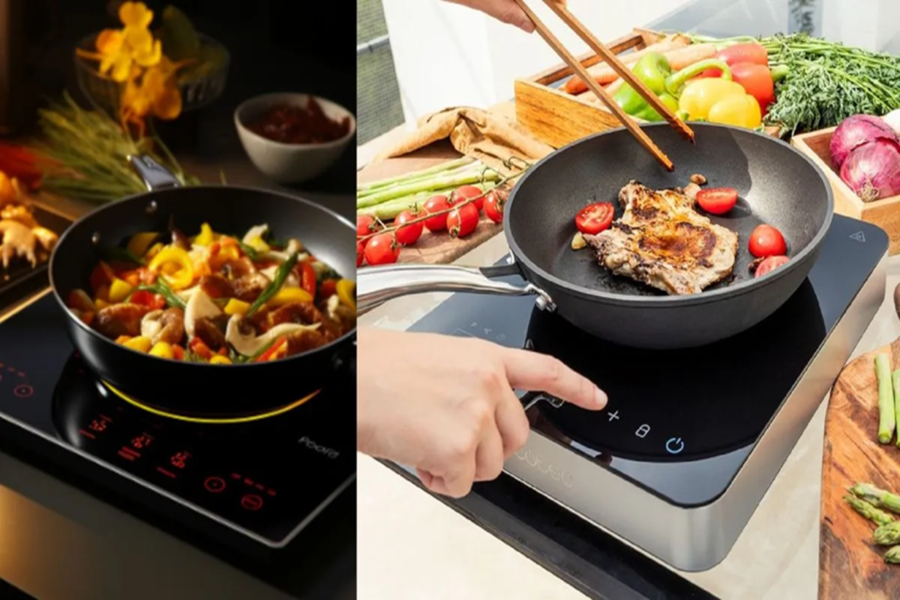
The impact of the ongoing conflict between the U.S., Israel, and Iran has begun to manifest clearly in the lives of ordinary people. In particular, the shortage of LPG and the uncertainty surrounding its supply have compelled people to seek out new alternatives. Consequently, in areas where power supply is reliable, the demand for induction cooktops has surged significantly.
Not only does this offer a faster cooking experience, but it is also considered superior in terms of energy efficiency and safety. However, shifting from gas to induction cooking is not as simple as it might appear. For first-time users, there are several small details that, if overlooked, can lead to complications. Therefore, it is essential to properly understand and utilize the various functions of an induction cooktop.
**How an Induction Cooktop Works**
An induction cooktop is a modern kitchen appliance that operates in a manner entirely distinct from traditional gas stoves. It does not rely on an open flame; instead, it heats the cookware directly through electromagnetic energy. This means that heat is generated directly within the vessel itself, rather than being applied externally.
Thanks to this technology, food cooks much faster, and energy wastage is minimized. A key feature is that the surface of the cooktop does not become excessively hot, thereby significantly reducing the risk of burns. For this very reason, it is widely regarded today as a safe and smart option for cooking.
**Not All Cookware Works on Induction**
The most common mistake people make when using an induction cooktop is selecting the wrong type of cookware. People often assume that any steel or metal vessel will work on an induction surface; however, this is not the case. An induction cooktop functions only with cookware that possesses magnetic properties—meaning that if a magnet sticks to the bottom of your vessel, it is suitable for use on an induction cooktop.
Many types of stainless steel cookware, aluminum vessels, or traditional *kadhai* (wok-style pans) will not work on this appliance. Therefore, it is advisable to select cookware that is specifically designed for use on induction cooktops. The right cookware not only makes cooking easier but also enhances the functionality of the cooktop.
**Why a Flat Base is Essential**
In induction cooking, it is not just the material of the cookware that matters, but its shape as well. Specifically, the bottom—or base—of the vessel must be perfectly flat. Cookware commonly used in Indian kitchens, such as *kadhai* (wok-like pans) or *tavas* (griddles), often have slightly curved bases; this prevents them from making full contact with the induction surface.
Consequently, the food either fails to cook properly or the cooktop repeatedly shuts down. Cookware with a flat and thick base is considered ideal for induction cooking. This ensures that heat is distributed evenly, resulting in a smooth and efficient cooking process.
**Do Not Overlook Electrical Capacity**
An induction cooktop operates on electricity, and its power consumption typically ranges between 1200 and 2000 watts. Therefore, if your home's electrical wiring is old or if multiple heavy-duty appliances are running simultaneously, this can lead to complications.
It is frequently observed that fuses blow or voltage fluctuations occur while using an induction cooktop. It is, therefore, crucial to assess your home's electrical capacity and consult an electrician if necessary. This simple step can save you from significant trouble, particularly once you begin using the induction cooktop for your daily cooking needs.
**Adjusting Your Cooking Style**
If you have been cooking on a gas stove for years, switching to an induction cooktop may feel a bit unfamiliar at first. With gas, you gauge the required heat intensity by observing the flame; however, with induction, you must rely on specific temperature or power settings. You may need to make slight adjustments to traditional Indian cooking techniques—such as deep-frying, simmering, or sautéing spices.
While this may seem challenging initially, cooking becomes much easier as you begin to understand the various settings. Selecting the appropriate temperature is the key to achieving excellent results when cooking on an induction cooktop.
**Why Proper Placement is Essential**
The performance of an induction cooktop depends not only on its features but is also significantly influenced by its placement. Many people place it in a corner of the kitchen or right up against a wall, which obstructs ventilation.
An induction cooktop features a cooling system that requires airflow to function correctly. If the air vents become blocked, the cooktop may shut down automatically. Therefore, always place it in a level, open, and well-ventilated area. This will not only enhance its performance but also extend its lifespan.
**Precautions During Induction Use**
While an induction cooktop is undoubtedly safe, using it correctly is absolutely crucial. Even slight negligence can lead to damage or malfunction.
First and foremost, always keep the induction cooktop in a dry and clean environment. Using it on a wet surface poses a risk of electric shock. Additionally, never touch the plug or control buttons with wet hands.
Do not switch on the cooktop with an empty vessel placed on it; this can cause damage to both the vessel and the cooktop. Similarly, avoid using vessels that are either too small or too large, as this prevents proper heating.
When cooking on the induction cooktop, avoid dragging vessels across the surface, as this can cause scratches. Always lift the vessel when placing it on or removing it from the cooktop.
Keep children away from the induction cooktop, especially when it is switched on. Although the cooktop's surface itself does not become excessively hot, the vessel remains hot, posing a risk of burns.
Never block the cooktop's air vents. If airflow is obstructed, the unit may overheat and shut down automatically.
Always use the correct voltage and a high-quality electrical socket. Loose plugs or faulty wiring increase the risk of short circuits.
If you notice any unusual noises, a burning smell, or an error message emanating from the cooktop, switch it off immediately and have it inspected. Ignoring this could be harmful.
Disclaimer: This content has been sourced and edited from Dainik Jagran. While we have made modifications for clarity and presentation, the original content belongs to its respective authors and website. We do not claim ownership of the content.
