
How Does a Ropeway Operate Thousands of Feet Up? After the Gulmarg Tragedy, Discover the Technology Behind It..
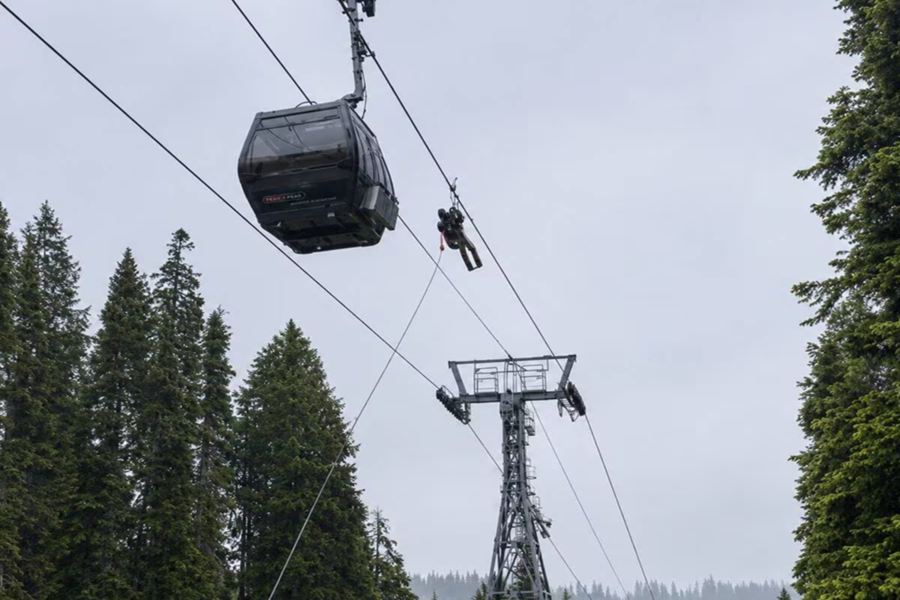
On Monday, a sudden technical glitch in the Gulmarg Gondola—Asia's highest and the world's second-largest and longest cable car (ropeway)—in Gulmarg, Jammu and Kashmir, left everyone terrified. Due to this malfunction, the ropeway came to a standstill mid-air, leaving approximately 300 tourists stranded at an altitude of several hundred feet. The administration immediately launched a rescue operation to safely evacuate the tourists. But do you know how cable car technology actually works and how it manages to lift heavy loads thousands of feet into the air? Let's find out.
**How Ropeway Technology Works**
A ropeway or gondola cable car system represents a perfect synergy of mechanical and electrical engineering. It features large wheels—known as driving pulleys—installed at the stations, which are driven by powerful electric motors. A strong, continuous-loop steel cable constantly circulates these pulleys. When the main motor drives the pulleys, it pulls the entire steel cable forward, causing the cabins—which are securely attached to the main cable—to move from one station to the next.
**Ropeway Speed Control Technology**
Modern ropeways utilize a "detachable mechanism" technology to ensure the comfort and safety of passengers. When a cabin arrives at a station, it automatically detaches itself from the high-speed main cable with the help of a special grip. Inside the station, small wheels (tires) are installed to propel the cabin forward at a very slow pace, allowing passengers to safely board and disembark. As the cabin departs the station for its return journey, these same wheels accelerate its speed, enabling it to securely reattach to the main cable.
**The Function of Cable Car Towers and Rollers**
Along the long stretch between two stations, large pillars—known as towers—are erected at intervals to support the heavy cable suspended in the air. The upper sections of these towers are fitted with special rollers made of rubber and steel, over which the heavy cable glides smoothly as it moves forward. These rollers maintain the cable at a specific height in the air and keep it aligned along the correct path, ensuring it does not sag. It is precisely because of these towers that cable cars can traverse through the mountains at altitudes of hundreds of feet without any interruption.
**Just How Much Weight Can a Cable Car Lift?**
Large ropeway systems, such as the Gulmarg Gondola, are designed in strict adherence to rigorous safety standards. Typically, a single cabin or car can comfortably accommodate six to eight adult passengers. In terms of weight capacity, a single cabin is fully capable of lifting a load ranging from approximately 600 to 800 kilograms. Since multiple cabins operate simultaneously along the entire ropeway line, the main steel cable is engineered to withstand the combined weight of several tons as well as immense wind pressure.
**What Safety and Braking Mechanisms Are in Place?**
To ensure the safety of tourists, this entire system incorporates multiple layers of safety protocols and automatic braking mechanisms. Should the main power supply fail or a malfunction occur in the motor, the system's emergency brakes activate instantly, bringing the cable car to a complete halt. Furthermore, a secondary diesel engine is always kept on standby as a backup in the event of a main motor failure. This backup engine operates the cable at a very slow speed, serving to safely transport any cabins stranded in mid-air to the nearest station.
**What Factors Are Responsible for Accidents?**
There can be various technical reasons for malfunctions within a ropeway system. On occasion, sudden strong winds or adverse weather conditions may trigger sensors to automatically lock the system as a safety precaution. Additionally, malfunctions in the wheels that drive the cable, sudden fluctuations in the power supply, or glitches in the electronic control panel can also cause a cable car to stall mid-journey. In locations like Gulmarg, extreme cold temperatures and heavy snowfall can sometimes lead to such mechanical issues within the system's components.
Disclaimer: This content has been sourced and edited from TV9. While we have made modifications for clarity and presentation, the original content belongs to its respective authors and website. We do not claim ownership of the content.
