
Government's major move regarding children's social media usage! Restrictions could be imposed on creating accounts..
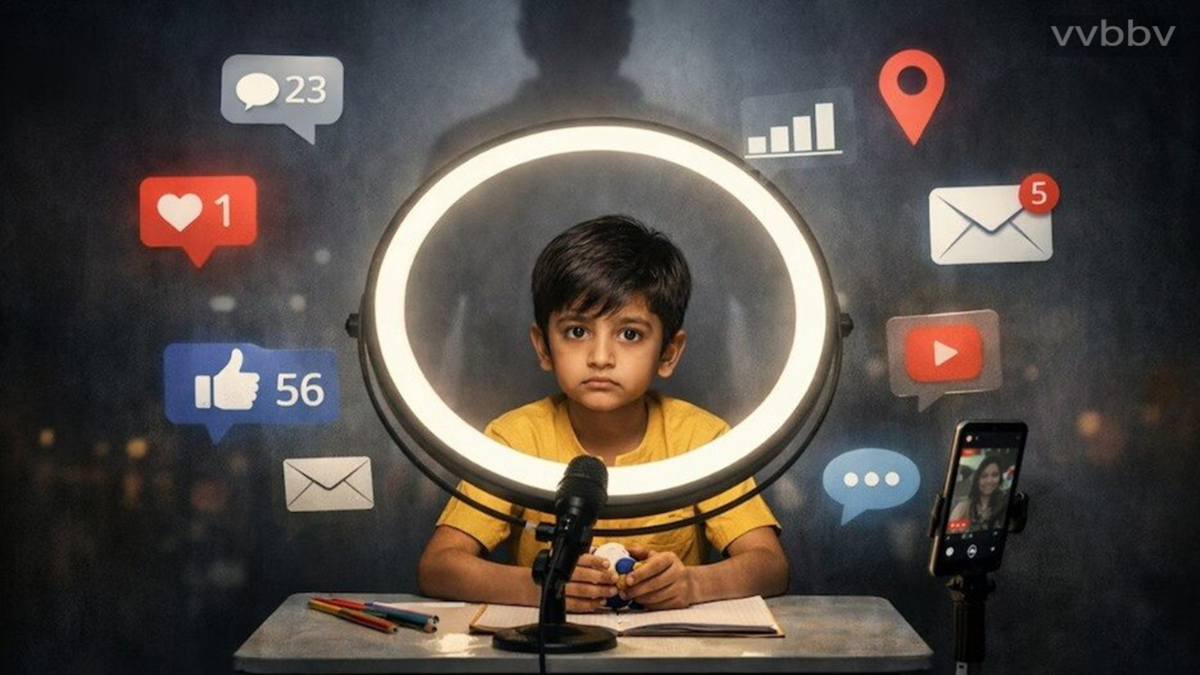
The Central Government is preparing to take a major step regarding children's use of social media. The Centre informed the Supreme Court that it is considering amendments to the Information Technology (Intermediary Guidelines and Digital Media Ethics Code) Rules. Under these proposed changes, children under the age of 18 could be barred from creating accounts on social media platforms.
This matter arose during the hearing of a petition concerning children's online safety, filed by an NGO named the 'Just Rights for Children Alliance.' The organization has expressed concern over various potential risks associated with children using digital platforms.
**Move to Restrict Accounts for Those Under 18**
Solicitor General Tushar Mehta, representing the Centre in the Supreme Court, stated that the government would move towards implementing a system for social media intermediaries that prevents children under 18 from creating accounts on these platforms.
The hearing took place before a bench comprising Chief Justice of India Surya Kant and Justices Joymalya Bagchi and V. Mohana. During the proceedings, the legal status of agreements between minors and social media companies was also discussed. The government submitted that the restriction on minors opening social media accounts should be explicitly incorporated into laws or rules, rather than remaining merely a guideline; this would make compliance mandatory for social media companies.
**Separate Arrangement for Educational Websites**
During the hearing, Tushar Mehta also noted that memberships for educational websites could be obtained with parental consent. In other words, the proposed framework would specifically focus on social media accounts, while allowing for parental consent in the case of online platforms related to education. The Court emphasized the need for technology to align with Indian law.
During the hearing, Justice Joymalya Bagchi questioned how social media platforms operating in India are applying age-related regulations that are enforced in other countries.
The Court also asked the government to consider requiring social media platforms to align their technology and software with Indian law. This implies that merely formulating rules is insufficient; the platforms' systems must incorporate mechanisms that prevent individuals below the prescribed age from registering accounts.
The Solicitor General assured the Court that social media intermediaries are required to comply with Indian law. He stated that steps could be taken in this direction and that the government would take action on the matter.
Why did the issue of children's online safety arise?
The NGO that filed the petition has highlighted several potential risks associated with children's use of social media. These include online grooming, sexual exploitation, trafficking, behavioral profiling based on online activities, misuse of personal data, cyberbullying, and access to age-inappropriate content.
The petitioner argues that the absence of an effective and uniform method for enforcing age restrictions on social media accounts for children could compromise their online safety.
What happens next?
Currently, the proposal to restrict social media accounts for individuals under the age of 18 has emerged as a potential legal amendment. The Centre has informed the Supreme Court of its intention to provide a legal basis for such restrictions by amending the rules. If implemented, this change could make social media companies responsible for preventing minors from registering accounts. This might necessitate the implementation of technical measures, such as age verification systems. The matter is currently undergoing legal proceedings, and the situation will become clearer based on the rules proposed by the Central Government and the directives issued by the Supreme Court.
Disclaimer: This content has been sourced and edited from TV9. While we have made modifications for clarity and presentation, the original content belongs to its respective authors and website. We do not claim ownership of the content.
