
Fire Safety: UPPCL Warning—Using the Wrong Plug in an Extension Board Can Cause a Fire; Do Not Commit This Act of Negligence..
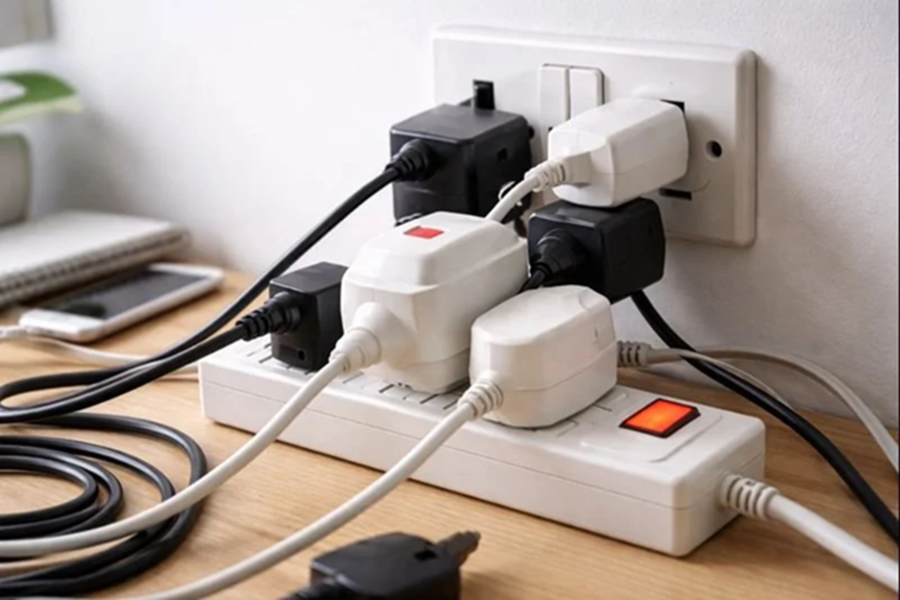
Extension Board Fire Risk: If you, too, place an excessive load on an extension board, it can significantly increase the risk of short circuits and fires. The Uttar Pradesh Power Corporation Limited (UPPCL) has advised the public to exercise caution. In light of this, read this article to learn how many plugs can be safely connected to an extension board and which appliances should be kept away from it.
What Warning Did UPPCL Issue?
Warning the public via the social media platform X, the Uttar Pradesh Power Corporation Limited stated that placing an excessive load on an extension board can become a major cause of fires. This risk is particularly heightened during the summer months due to the increased usage of electrical appliances.
How many plugs are in an extension board? How many plugs are it safe to connect to an extension board?
Most extension boards feature slots for connecting 3 to 4 plugs; however, it is crucial to understand that safety does not depend solely on the number of plugs. The critical factor is the board's total load capacity. If you are running low-power devices—such as mobile chargers, laptops, or TVs—they can generally be used simultaneously without issue. However, if you connect appliances that draw heavy amounts of power, the board may become overloaded.
Why is it Important to Understand Load?
When purchasing an extension board, you must check its Ampere (A) and Wattage capacity. In most households, extension boards capable of handling a load between 1000W and 1500W are commonly used. Given that the standard power supply in India is approximately 220V, if a board is rated at 6A, its maximum capacity is approximately 1320W. This means that if the total load exceeds this limit, the wires will begin to overheat, thereby increasing the risk of a short circuit.
Extension board load capacity calculation: How to calculate Volts and Amperes yourself
As per UPPCL's advice, always check the ratings printed on the back of the extension board or on its packaging before using it. In India, there is a straightforward formula for calculating power supply and an extension board's capacity:
Total Wattage = Volts × Amperes
Typically, the standard extension boards found in our homes are rated at 6 Amperes (6A). The standard power supply in India is 220V. Based on this calculation—220V × 6A = 1320 Watts—your 6A extension board can safely handle a load of up to approximately 1320 watts. Once you grasp this simple math, you will instinctively know which appliances can be plugged in simultaneously and which ones should be operated individually.
Which appliances should be kept away from extension boards?
Some electronic appliances draw a significant amount of power. You should avoid plugging these into an extension board. Such appliances include electric kettles, microwaves, electric irons, washing machines, refrigerators, and similar devices. Few people realize that an electric kettle alone can draw a load of up to 1500 watts. Consequently, plugging it into a standard extension board can easily exceed the board's maximum capacity.
What are the risks associated with overloading?
People often wonder, "What could possibly go wrong if I plug everything in at once?" The reality is that doing so causes the wires to overheat; the insulation may melt, sparks may begin to fly, and a short circuit could occur. All of these factors significantly increase the risk of a fire breaking out. This is precisely why the UPPCL (Uttar Pradesh Power Corporation Limited) has advised the public to remain vigilant and take necessary precautions.
Electrical Fire Prevention at Home: Precautions to Take When Using Extension Boards
Always check the board's rating: Make sure to understand the wattage and amperage capacity printed on the back of the extension board, as explained above.
Plug heavy-duty appliances directly into wall sockets: Avoid plugging appliances such as heaters, geysers, or microwaves into an extension board.
Do not overload the board: As a general rule, do not push the extension board to its absolute maximum capacity. It is safer and advisable to utilize it at no more than half of its rated load.
Immediately replace boards with faulty wiring: If you notice the extension board overheating or if sparks begin to fly, stop using it immediately.
Disclaimer: This content has been sourced and edited from Amar Ujala. While we have made modifications for clarity and presentation, the original content belongs to its respective authors and website. We do not claim ownership of the content.
