
Fake Mobile Charger: How to identify if your phone charger is real or fake? Learn some amazing tricks..
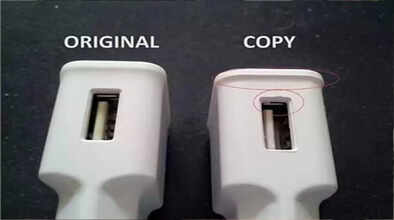
When their mobile phone charger breaks, many people impulsively buy a charger from any company they find in the market. Often, we think that any charger will do the job, but this thinking can seriously damage your phone. Many chargers available in the market are sold under brand names, but their quality is completely different from genuine chargers. Such chargers not only damage the phone's battery but can also cause so much damage that you might have to replace your entire phone.
Why are fake chargers so dangerous?
Fake chargers use cheap and low-quality parts. They heat up quickly during charging, increasing the risk of frequent short circuits, which can lead to accidents like fires.
Fake chargers fail to provide the correct voltage and amperage. This disrupts the battery's charging cycle. The risk of the battery swelling, overheating, or sudden damage increases.
An incorrect voltage supply can damage the phone's motherboard and charging integrated circuit (IC), potentially rendering the entire phone useless.
How to differentiate between a genuine and a fake charger?
A genuine charger is slightly heavier because it uses high-quality plastic, transformers, and internal components. Fake chargers feel lighter and weaker due to the use of low-quality parts.
The printing on branded chargers is clear, uniform, and accurate. In contrast, the printing on fake chargers is faint, blurry, or contains spelling mistakes.
If a genuine charger from a company costs 1,000-1,200 rupees, and a charger of the same brand is available in a shop for 250-300 rupees, it's a clear indication that it's fake. Local chargers are also sold with company names printed on them.
Fake chargers can be identified using the BIS Care App. You need to enter the product registration number of the charger in the app. If the charger doesn't appear as registered in the app, assume it's fake.
Disclaimer: This content has been sourced and edited from Amar Ujala. While we have made modifications for clarity and presentation, the original content belongs to its respective authors and website. We do not claim ownership of the content.
