
Explained: What is Liquid Cooling? It keeps AI data centers cool while saving electricity and water..
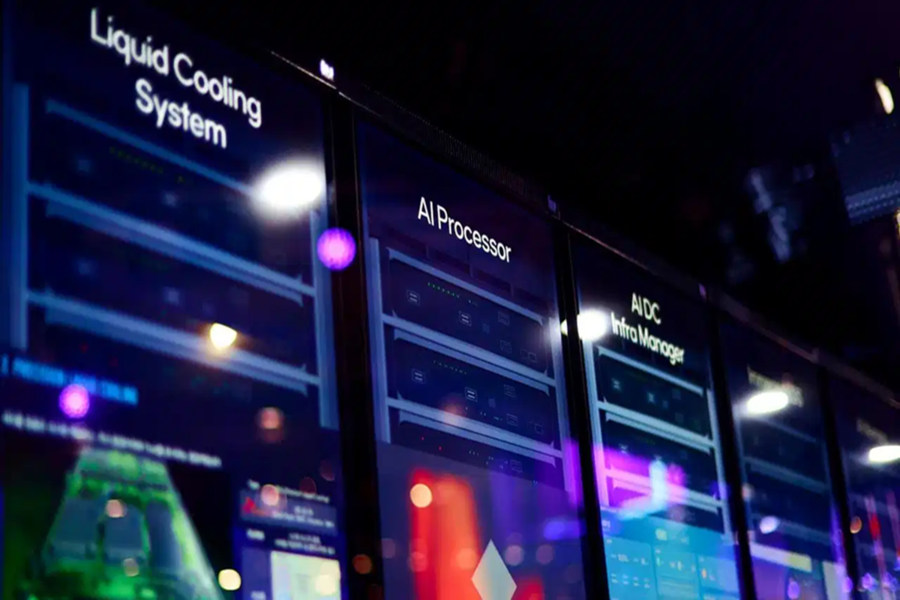
We are living in the era of AI, where many advanced AI models require massive AI factories or data centers to operate. In these facilities, powerful GPUs and supercomputers work around the clock to process data. During data processing, the chips generate so much heat that even air conditioning fails to cool them down effectively. Consequently, various methods are being employed to manage heat amidst the surging demand for AI and the proliferation of data centers; liquid cooling is one such method.
**What is Liquid Cooling?**
Liquid cooling is an advanced method for managing heat in data centers. It utilizes specialized fluids—such as dielectric liquids—designed to absorb and dissipate heat from high-performance servers. This method is highly effective and essential for handling the immense power density of modern AI hardware. It is widely acknowledged that liquids possess a greater capacity for heat absorption compared to air.
To put it simply, liquid cooling involves a closed-loop piping system that delivers cool liquid to metal plates mounted atop the GPUs. As the liquid flows across these plates, it absorbs the heat generated by the chips. The heated liquid is then routed to a heat exchanger, where it is cooled down again, and the cycle repeats.
**Liquid Cooling in NVIDIA’s Rubin Architecture**
NVIDIA’s "Rubin" generation of AI infrastructure marks the world's first instance of 100% liquid cooling implementation, where every single chip and networking component is cooled entirely by liquid.
No Water Usage
Ali Heydari, Director of Data Center Cooling and Infrastructure at NVIDIA, stated that the NVIDIA DSX reference design for AI factories involves zero water consumption; they have eliminated the use of significant amounts of electricity and almost all water. Designs utilizing dry coolers employ a closed-loop system that does not rely on evaporative water cooling, although chillers may be required during specific weather conditions.
Electricity Savings Through Liquid Cooling
You might be surprised to learn about data center power consumption: cooling accounts for up to 40 percent of the total electricity used. Simply put, 40 percent of the total power consumed by a data center goes toward keeping it cool. NVIDIA’s 45-degree liquid cooling architecture enables chiller-less operation alongside dry coolers, thereby reducing annual water consumption.
Electricity in data centers is not used solely to power supercomputers; as mentioned earlier, an almost equal amount of power (approximately 40 percent) is consumed by the air conditioners and blower fans required to keep the systems cool.
The primary benefit of liquid cooling is that it eliminates the need to operate massive air conditioners and fans. While liquid cooling does require electricity, circulating the liquid through pipes can be achieved using small pumps that consume very little power, resulting in overall energy savings.
How is Water Saved?
Traditional air-cooled data centers rely on evaporative cooling technologies—such as chillers—which dissipate heat by evaporating water. Consequently, hundreds of thousands of liters of water are wasted daily. On the other hand, advanced AI data centers are employing 100% closed-loop liquid cooling. In this system, the liquid circulates continuously within the piping network; it neither comes into contact with the air nor evaporates, meaning the same liquid is recycled repeatedly.
Disclaimer: This content has been sourced and edited from TV9. While we have made modifications for clarity and presentation, the original content belongs to its respective authors and website. We do not claim ownership of the content.
