
Explained: What Is ChatGPT Health and How It Changes the Way You Manage Medical Information
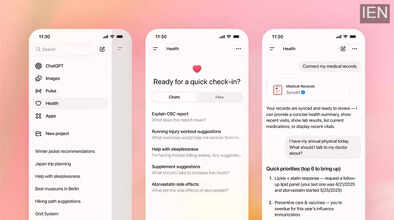
OpenAI has introduced ChatGPT Health, a dedicated and secure health-focused space within ChatGPT designed to help users understand medical information using their own real-world health data. With this launch, OpenAI is taking a significant step toward making health conversations more personalized, private, and useful—while clearly positioning the tool as a support system, not a replacement for doctors.
The feature is currently available on web and iOS and is being rolled out gradually through a waitlist for Free, Go, Plus, and Pro users. Android support is planned but no official timeline has been announced yet.
Why ChatGPT Health Matters Right Now
Health-related queries are already one of the most popular use cases for ChatGPT. According to OpenAI, more than 230 million people worldwide use ChatGPT every week to ask health and wellness questions. ChatGPT Health builds on this behavior by creating a separate, privacy-focused environment specifically designed for medical data and health conversations.
Unlike general chats, this new space offers stronger encryption, data isolation, and enhanced privacy controls, recognizing that medical information requires a much higher level of protection and accuracy.
What Can You Do With ChatGPT Health?
1. Connect and Understand Medical Records
The standout feature of ChatGPT Health is medical record integration. Through a partnership with b.well, a healthcare data network in the US, users can securely connect to their doctor’s portal. This allows ChatGPT Health to access:
-
Lab test results
-
Visit summaries
-
Clinical history
Once connected, users can ask practical questions such as:
-
“How do my cholesterol levels compare to last year?”
-
“Can you summarize my blood reports before my doctor’s appointment?”
At present, medical record integration is limited to the United States, and users must be 18 years or older to enable this feature.
2. Sync Fitness and Lifestyle Data
ChatGPT Health also integrates with Apple Health, allowing users to analyze data related to:
-
Physical activity
-
Sleep patterns
-
Movement and workouts
This feature requires an iPhone running an updated version of iOS.
In addition, several lifestyle-focused apps are part of the initial rollout:
-
Peloton suggests workouts tailored to your fitness data
-
Instacart turns meal plans into grocery orders
-
AllTrails recommends hikes based on your fitness level
These integrations aim to bridge the gap between health insights and everyday action.
How ChatGPT Health Protects Your Personal Data
Privacy is a central pillar of ChatGPT Health. OpenAI has implemented what it calls “purpose-built encryption and isolation.”
Key privacy features include:
-
Health chats and files are stored in a separate Health section
-
Health conversations do not appear in regular ChatGPT chats
-
Health data is not used to train OpenAI’s AI models
-
Users can delete health memories at any time
-
Disconnecting medical records also removes data from b.well’s systems
Importantly, data flow works in only one direction. While ChatGPT Health can use general context (such as a recent move or lifestyle change mentioned elsewhere) to improve responses, health data never flows back into general chats.
Third-party app access is turned off by default and requires explicit user permission.
Built With Doctors, Not Just Algorithms
OpenAI emphasizes that ChatGPT Health was developed with extensive medical oversight. The company collaborated with more than 260 physicians across 60 countries, who reviewed AI-generated responses over 600,000 times.
This work led to the creation of HealthBench, a specialized evaluation system that checks:
-
Clinical reasoning quality
-
Safety risks
-
Whether the AI knows when to recommend seeing a doctor
The system runs on GPT-5.2, a version of OpenAI’s model fine-tuned specifically for healthcare use. It also underwent multiple rounds of doctor-led “red teaming”, where medical professionals deliberately tried to push the AI toward unsafe advice to identify and fix weaknesses.
What ChatGPT Health Is Not Designed to Do
OpenAI is clear about the limits. ChatGPT Health does not diagnose diseases or prescribe treatments. Its role is to:
-
Help users understand medical reports
-
Prepare questions for doctor visits
-
Answer general health and wellness queries
When necessary, the AI will advise users to consult a healthcare professional and indicate how urgent that consultation may be.
The Bottom Line
ChatGPT Health represents a major shift in how people can interact with their medical information—making it easier to understand, better organized, and more private. While it doesn’t replace doctors, it can help users become more informed, prepared, and confident when managing their health.
As digital health tools continue to evolve, ChatGPT Health stands out for its focus on privacy, medical oversight, and real-world usability, marking an important step toward responsible AI in healthcare.
