
Electric Diya: No switch, no power cord… how does this diya start glowing the moment a drop of water falls on it?
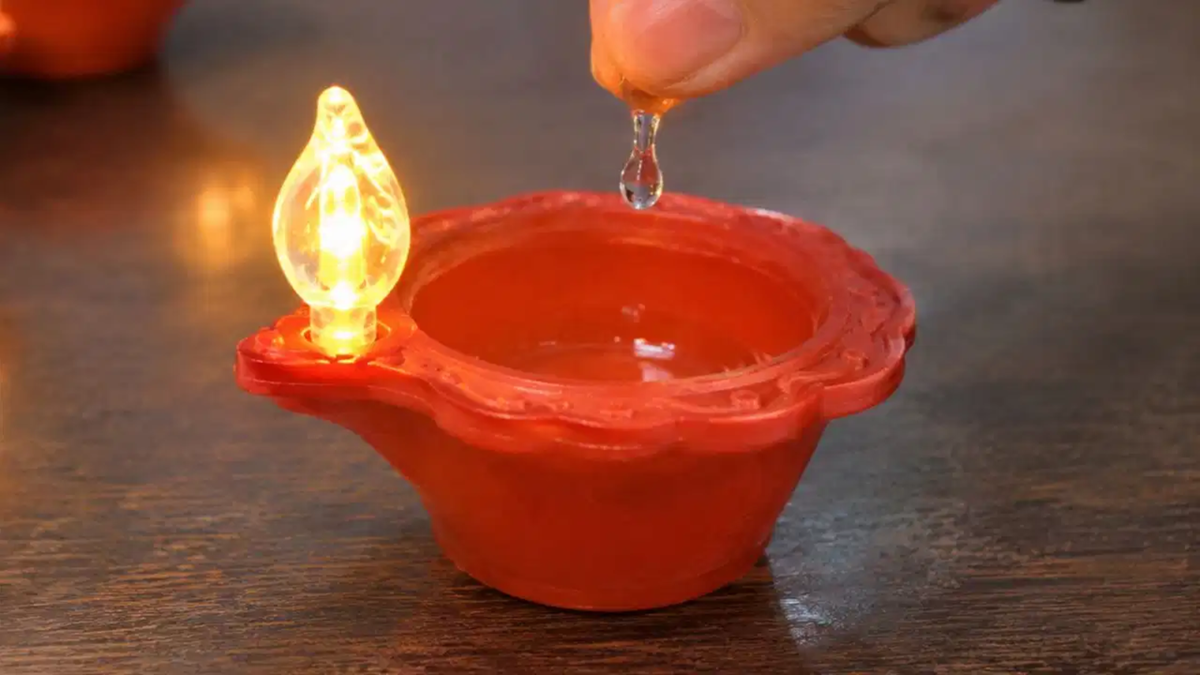
Electric Diya: During the festival of Diwali, traditional earthen lamps (diyas) fueled by ghee or oil can be seen in every home. These lamps hold special significance during this festival of lights. Just as everything else is becoming high-tech, Diwali lamps have also evolved to become 'smart.' Nowadays, alongside traditional earthen lamps, the market offers electric lamps that are activated by water. While they look just like conventional diyas, they require neither oil nor cotton wicks. Surprisingly, they don't even have an on/off switch; they begin to glow the moment a spoonful of water is poured into them. While water typically damages electronic devices, these lamps actually function because of it—powered by a clever yet simple technology.
A Smart Electronic Circuit Hidden Inside a Small Diya
Inside these water-activated lamps, there isn't a complex machine, but rather a smart electronic circuit. If you look closely at the top of the diya, you will see a small LED light in the center. Right next to this light are two small metal points, or pins. In technical terms, these are known as electrodes or water sensors.
Concealed in the base of the diya is a small button-cell battery—the kind typically used in wristwatches. When the diya is dry, one wire from the battery connects to the LED bulb, while the other remains disconnected due to the gap between the two metal pins. This is known as an 'open circuit.' As long as there is no connection between the two pins, the current from the battery cannot reach the bulb; hence, the diya remains off when dry.
Minerals in the Water Create a Bridge for the Current
The process begins the moment water is poured into the diya. The water that comes into our homes contains various dissolved natural minerals, such as calcium, magnesium, and sodium. In scientific terms, these microscopic elements are called ions. When a small amount of water is poured into the *diya* (lamp), it submerges both metal pins. The minerals present in the water act as a bridge between these two pins.
However, water alone can only conduct a very weak current. To address this, a small transistor is integrated into the *diya*. This transistor detects the faint signal generated by the water and acts as a main switch, channeling the full power from the battery to the LED bulb. Thus, as soon as water is added, the circuit is completed, causing the *diya* to light up instantly.
Why doesn't this *diya* work with RO-purified water?
People often wonder if any type of water can be used in this *diya*. If you use distilled water (the kind used in batteries) or highly filtered RO water, the *diya* might not light up at all, or it may glow very dimly. The reason is simple: the natural minerals are removed during the extensive filtration process. Without these minerals, the water cannot conduct an electric current. If you encounter this issue, simply adding a pinch of salt to the water will allow it to function immediately.
Battery backup and how to turn it off
These high-tech *diyas* utilize LED technology, which consumes a negligible amount of electricity. The three small button-cell batteries inside provide a continuous backup of 40 to 50 hours. Turning off the *diya* is also very simple: just pour out the water and wipe the *diya* dry with a cloth. As soon as both metal pins dry, the circuit breaks, causing the light to turn off immediately. If the battery ever runs out, you can easily replace it with a new button cell by opening the cover on the bottom.
Disclaimer: This content has been sourced and edited from TV9. While we have made modifications for clarity and presentation, the original content belongs to its respective authors and website. We do not claim ownership of the content.
