
Don't Fall for the Reels Trap: How Fin-Influencers Are Making People Victims of Fraud..
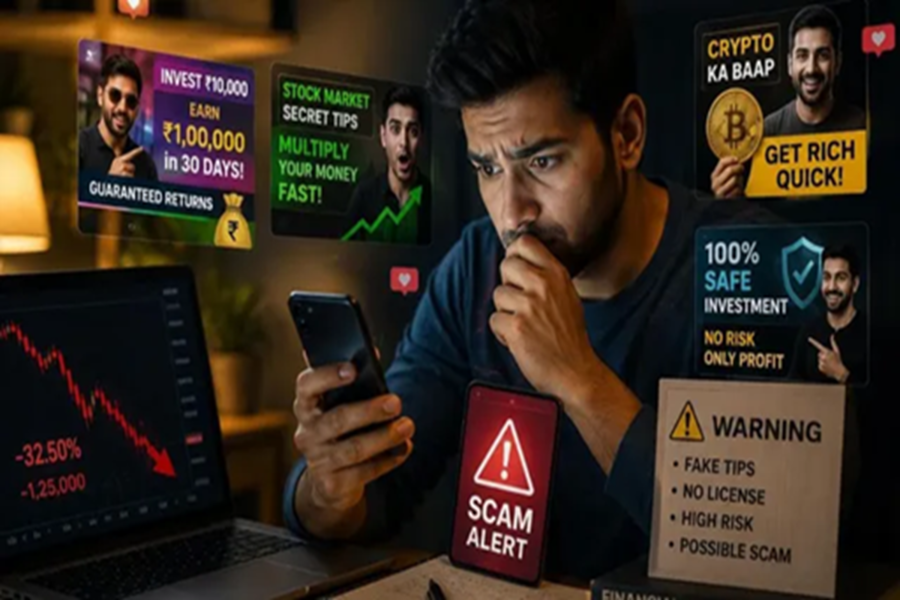
If you are scrolling through Reels on Instagram or YouTube and stumble upon a suggestion to double your money—or perhaps see someone offering a foolproof formula for making a quick fortune by investing in stocks or crypto—chances are you will watch that Reel to the very end. Furthermore, there is a distinct possibility that, within just a few minutes, you might even proceed to download an app and begin the process of opening a Demat account.
In fact, thousands of people are doing exactly this. They have transformed into new-age investors simply by watching videos on Instagram or YouTube. There was a time when discussing financial investment or savings was considered a rather dull or overly serious subject; however, times have certainly changed.
Today, advice regarding investment and savings is vastly different from that of our grandparents' era. New investors do not want to miss out on any opportunity to generate high returns in a short span—a phenomenon for which there is a specific term: 'FOMO,' or the "Fear of Missing Out."
It is precisely this anxiety that "Fin-influencers"—financial influencers who have mushroomed across social media platforms over the past few years—capitalize upon. Driven by this very desperation to make money, many individuals are falling victim to scams. Last April, a case involving a fraudulent trading scam amounting to ₹9.31 crore came to light in Pune. Similarly, a businessman in Ludhiana fell victim to a crypto scam, suffering a staggering loss of approximately ₹20 crore.
**The Need to Beware of Fraudulent Advisors**
This threat is global in nature. According to a report by the U.S. Federal Trade Commission (FTC), people lost a staggering $2.1 billion to scammers on social media platforms last year alone. In India, the state of digital and financial literacy is even more concerning.
This is precisely why cases of fraud on social media platforms surface almost daily. Nevertheless, continuous efforts are being made to crack down on fraudulent investment advisors. Finance Minister Nirmala Sitharaman recently stated that it is unethical to exploit the trust of unsuspecting retail investors merely to generate personal income. Cases involving incitement to make fraudulent investments—facilitated through videos and apps on social media—are increasingly coming to light. These incidents even include instances where deepfake AI technology is used to impersonate political leaders in an attempt to lure people into investing their money. While SEBI is cracking down on unlicensed "fin-influencers" (financial influencers), raising awareness among users remains of paramount importance.
**How Ordinary Users Get Trapped**
New investors now have access to a wide array of novel and unique investment options, ranging from banking apps to cryptocurrencies. Millions of retail investors turn to social media influencers for financial guidance. Yet, many of these influencers lack any formal qualifications within the financial sector. Nevertheless, their extensive social media following, engagement strategies, and the art of connecting with people become their greatest assets.
Often, they offer risky trading tips and, at times, advocate practices that run counter to traditional financial advice. Most followers remain unaware that the very influencer they trust is creating such flashy content primarily to monetize their social media presence. Influencers frequently generate income through sponsored content partnerships with credit card companies and fintech firms.
On social media, a large "following" is the ultimate currency—surpassing the value of quality or professional qualifications. The larger an influencer's following, the greater their prestige and the more trust people place in them. Such individuals can be found across a multitude of platforms, including YouTube, Instagram, and Facebook.
**Is It Possible to Stop Them?**
As long as people continue to harbor dreams of becoming millionaires overnight, individuals exploiting such aspirations will persist in one form or another. We know, for instance, that junk food is detrimental to our health; yet, the market remains flooded with it simply because there is a vast consumer base eager to buy it.
The situation is much the same when it comes to influencers. Just as we exercise caution and scrutiny before purchasing a product, we must exercise equal vigilance before allowing ourselves to be swayed by the opinions and advice of others. We must understand that content consists not merely of ideas; rather, in today's times, it is being sold just like a product.
Disclaimer: This content has been sourced and edited from Dainik Jagran. While we have made modifications for clarity and presentation, the original content belongs to its respective authors and website. We do not claim ownership of the content.
