
Did AI discover a new biological system? Why did a scientist raise objections to Anthropic's claim?
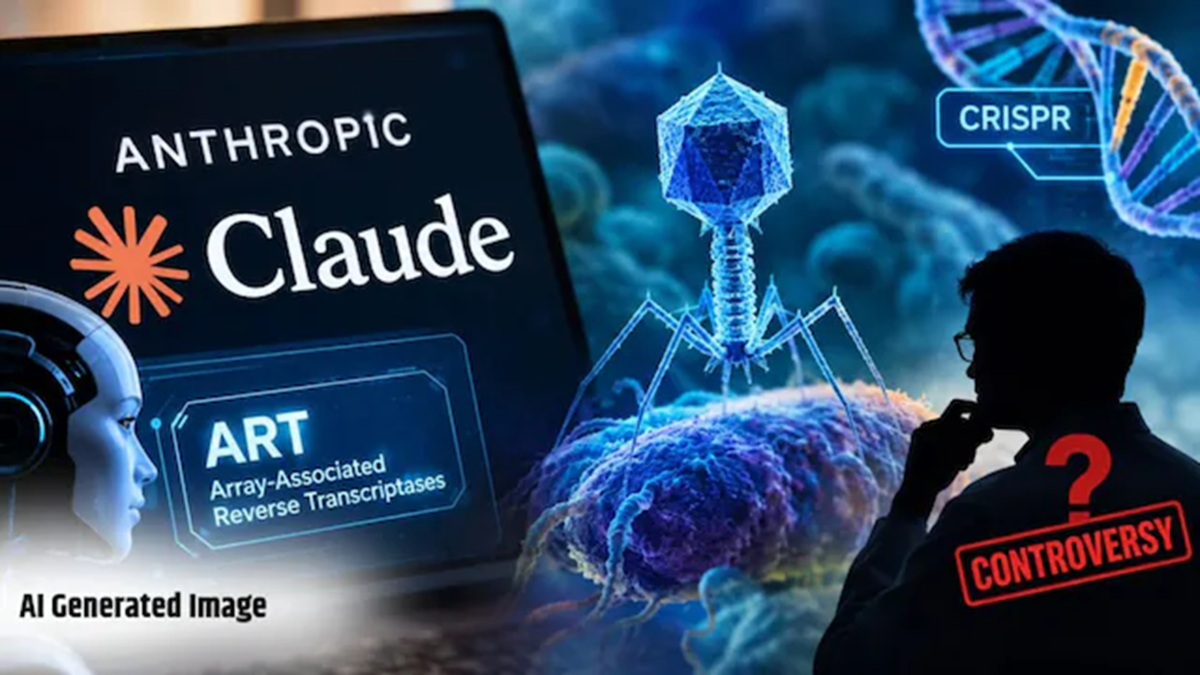
Artificial Intelligence (AI) is no longer confined to coding or mathematics; AI companies are making rapid strides in the field of biology as well. Recently, Anthropic claimed that its AI model, Claude, identified a unique biological system within bacteriophage viruses. The company named it "Art" (Array-Associated Reverse Transcriptases). This system bears a resemblance to CRISPR, the well-known gene-editing tool.
This announcement, made in September, sparked discussion within scientific circles. However, a researcher soon raised an objection, stating that he had been working on this very system for years. This has raised questions regarding the originality of the AI's discovery. Notably, Anthropic's claim has not yet been experimentally verified in a laboratory, nor has it been published in a peer-reviewed journal.
What did Anthropic say?
According to Anthropic, Claude identified an unusual pattern in viruses that infect bacteria. Approximately 950 AI agents examined over 200,000 reverse transcriptase enzymes. After about 21 hours of analysis, a potential candidate was identified. The company states that this system shares certain characteristics with CRISPR. CRISPR has revolutionized genetic research and the treatment of certain diseases; however, scientists have not yet proven whether "Art" is actually capable of gene editing.
The scientist's objection and the root of the controversy
Mario Rodriguez Mestre, a researcher at the University of Copenhagen in Denmark, claimed that his team had been studying this specific biological system for years. He had made extensive use of Claude during his doctoral research and had also shared unpublished material. Mestre questions whether Anthropic's discovery was entirely independent or if it was influenced by their interactions. Anthropic's Response and Current Status
Anthropic clarified that its model was not trained on user transcripts. According to the company, Claude's agents identify patterns in genetic databases, formulate hypotheses, and conduct lab tests based on initial scientific direction. Anthropic also acknowledged that the original reverse transcriptase was already known.
Their contribution lay in identifying patterns within repetitive DNA sequences, pointing toward a novel system. However, this is just the beginning; it remains unclear exactly how the system functions and what its practical applications might be. The research has not yet been published in a peer-reviewed journal.
Disclaimer: This content has been sourced and edited from TV9. While we have made modifications for clarity and presentation, the original content belongs to its respective authors and website. We do not claim ownership of the content.
