
Cell Broadcast: What is the technology that causes everyone's mobile phones to ring simultaneously when an alert arrives?
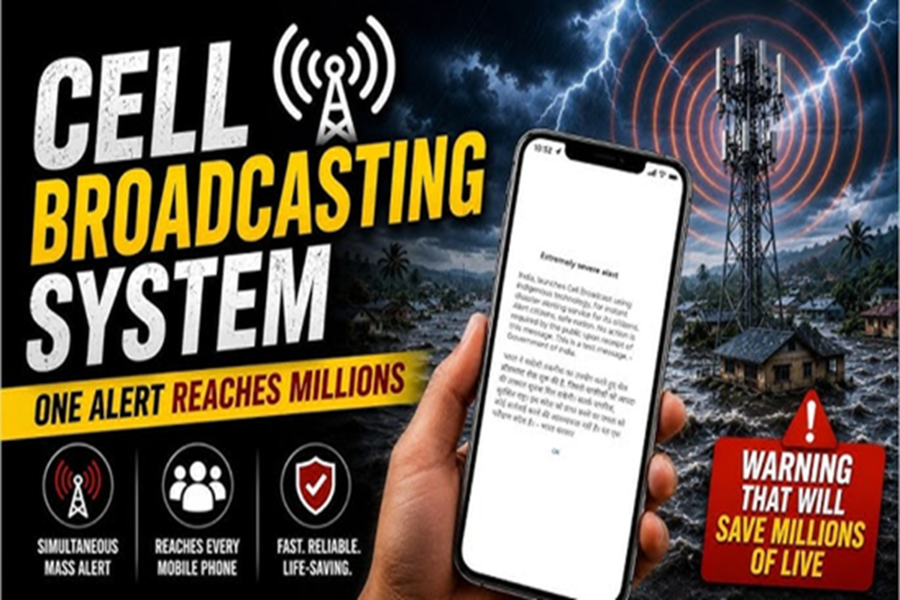
Cell Broadcast Technology: On Saturday evening, mobile phones held in people's hands and those lying nearby began to ring simultaneously. The screens displayed a message—accompanied by a red warning banner—reading "Extremely Severe Alert" in both English and Hindi. Even those whose phones were set to Silent or Do-Not-Disturb (DND) mode could not escape the loud, piercing sound. Initially, people were alarmed, fearing it might be a dangerous cyberattack or a scam. However, there was no need to panic; this was, in fact, the government's 'Cell Broadcast Alert'—a system designed to reach you even in the absence of an internet connection or during network congestion.
**Messages Delivered via This Technology**
The warning message that reached people's phones today was transmitted using Cell Broadcast Technology. This technology eliminates the need to send individual messages to specific mobile numbers. Instead, a mobile tower directly broadcasts the alert simultaneously to all phones present within its coverage area. This is precisely why warnings regarding storms, gales, and hailstorms reached the phones of millions of people within a matter of seconds. A key feature of this system is that alerts reach people rapidly—even when the network is busy or call traffic is high—ensuring that critical information is received promptly during emergencies.
**What is Cell Broadcast Technology?**
Cell Broadcast is an emergency communication technology that utilizes mobile networks to simultaneously deliver messages to all mobile phones located within a specific geographical area. Unlike standard SMS—which sends messages to individual numbers one by one—this system broadcasts alerts directly from the mobile tower across the entire locality. Consequently, the warning message appears on the screens of millions of people at the same moment, without placing any additional strain on the network infrastructure.
**How Does This System Differ from SMS?**
In the case of standard SMS, a separate message is sent to each mobile number. Consequently, sending messages to a large number of people simultaneously can cause the network to slow down. In contrast, the Cell Broadcast system allows a mobile tower to simultaneously transmit a message to all devices present within its coverage area; as a result, this technology remains highly effective even in situations where the network is congested or overloaded.
Who is operating this system in India?
In India, this technology has been developed through the collaborative efforts of the Department of Telecommunications (DoT), the National Disaster Management Authority (NDMA), and C-DOT. The indigenous 'SACHET' platform is utilized for this purpose. This system operates on 4G and 5G networks and, when necessary, can dispatch alerts specifically to residents of a particular state, district, or city.
How does the alert ring even when the phone is on silent mode?
Cell Broadcast Emergency Alerts differ from standard notifications. They are designed to immediately capture people's attention during critical situations. For this reason, even when a phone is set to Silent or 'Do Not Disturb' (DND) mode, a loud alarm often sounds, and a warning message appears on the screen.
Under what circumstances are such alerts issued?
The government employs this technology across a range of emergency scenarios; specifically, these messages are sent ahead of major public safety threats such as severe storms, hailstorms, floods, cyclones, earthquakes, and tsunamis. The primary objective is to minimize the loss of life and property by providing timely warnings to the public.
Disclaimer: This content has been sourced and edited from Amar Ujala. While we have made modifications for clarity and presentation, the original content belongs to its respective authors and website. We do not claim ownership of the content.
