
Android: Android to Also Receive iOS-like Unified Call Log; WhatsApp and Telegram Calls to Appear Directly in the Dialer..
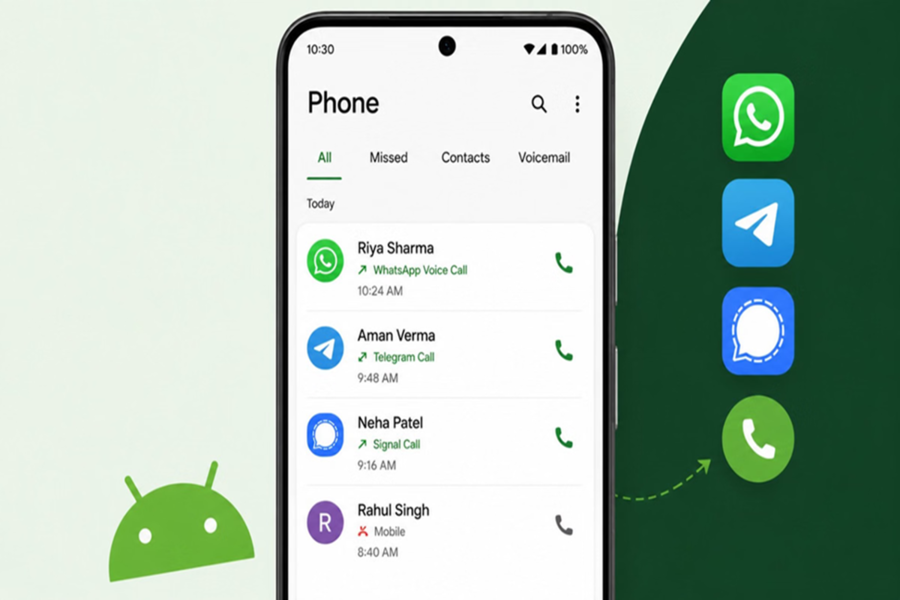
Google is introducing a feature for Android users that has been awaited for years. Soon, you will be able to view details of internet calls (VoIP) from apps like WhatsApp, Telegram, and Signal directly within your phone's default dialer (Phone App). While this update may sound minor, it will eliminate the hassle Android users face in managing calls across various separate applications.
**The Hassle of Constantly Switching Apps Will End**
Until now, the calling experience for Android users has been split into two distinct parts. On one side were standard calls—those received via a SIM card—which appeared directly in the phone's dialer; on the other were internet calls (VoIP) from apps like WhatsApp or Telegram. To view these internet calls, it was mandatory to open the specific app associated with them.
This experience has become quite cumbersome in today's digital landscape, primarily because most people now rely more on internet calling than on standard cellular calls. The current situation is such that if you miss a call on WhatsApp, you are forced to constantly switch between different apps just to check for it or to call back. Google's new update aims to put an end to this fragmented experience by consolidating all calling activity into a single location, thereby permanently resolving this daily inconvenience for users.
**The New Update Will Transform Your Calling Experience**
With the arrival of this new integration, your entire calling experience will undergo a complete transformation, becoming significantly more convenient. The most significant change will manifest in the form of a "Unified Call Log." Here, both your standard calls received via SIM and your internet calls will appear together in a single, unified list. Consequently, you will no longer need to repeatedly open different apps just to check for missed calls or review your recent call history.
Furthermore, you will now be able to call back directly on apps like Telegram or Signal right from your phone's default dialer. This eliminates the need to go through the tedious process of navigating to the specific app every time you wish to return a call. Overall, this change will prove to be extremely helpful for those who use various platforms to communicate with their office, family, and friends. This feature will not only make managing calls much easier but will also save your precious time.
**Now: An iPhone-like Experience**
This new change will bring Android's calling experience significantly closer to that of the iPhone (iOS). On the iPhone, thanks to Apple's CallKit, internet calls function exactly like standard phone calls. For years, Android users have been requesting a similarly seamless experience on their devices—a demand that Google is now finally set to fulfill.
**Comprehensive Focus on Privacy and Security**
Since this new feature involves the integration of third-party apps, Google has prioritized privacy above all else. Users will have complete control over which apps they wish to link with their main dialer. To enable this, users must explicitly grant permission themselves, thereby eliminating any risk of unwanted data sharing.
Furthermore, if you prefer to keep calls from a specific app—such as WhatsApp—separate from your main dialer, you will have the full option to disable this integration or configure it according to your personal preferences.
**Which Apps Will Be Supported?**
According to initial reports, this new feature will initially begin working with popular communication platforms such as WhatsApp, Telegram, and Signal. However, it will ultimately depend entirely on app developers to determine how they update and integrate their respective apps with Google's new telecom framework. In the future, as this system matures, it is expected that other major internet calling apps will also join the ecosystem, making your overall calling experience even more comprehensive and unified.
Disclaimer: This content has been sourced and edited from Amar Ujala. While we have made modifications for clarity and presentation, the original content belongs to its respective authors and website. We do not claim ownership of the content.
