
AI Summit Row: How a ‘Robodog’ Sparked Controversy for Galgotias University
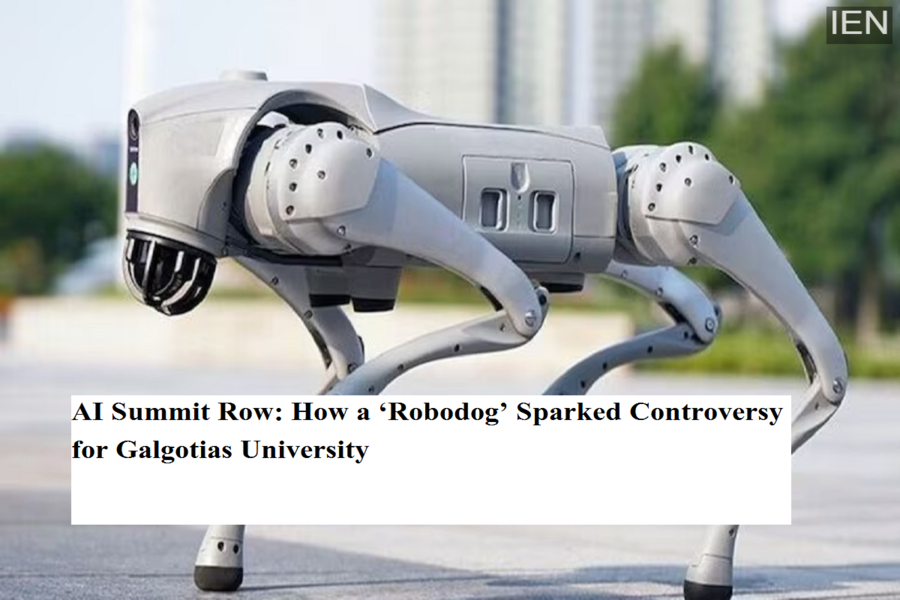
A four-legged metal machine that neither barks nor bites has unexpectedly become the center of a heated debate around innovation, branding, and transparency. The robotic dog—popularly known as a “Robodog”—triggered controversy after it was displayed at the India AI Impact Summit 2026, raising questions about claims of indigenous development and the broader image of India’s tech ecosystem.
Here’s a closer look at what happened, what a Robodog actually is, and how this technology evolved from novelty entertainment to advanced industrial and military applications.
What Happened at the AI Summit 2026?
The India AI Impact Summit 2026 was held at Bharat Mandapam in New Delhi starting February 16, inaugurated by Prime Minister Narendra Modi. The event aimed to showcase India’s artificial intelligence capabilities on a global stage, with participation from academic institutions, startups, and major technology firms.
During the summit, Galgotias University presented a robotic dog named “Orion” at its exhibition stall. In a video shared online, a university representative described the robot as part of work conducted at its Center of Excellence.
However, social media users quickly identified the device as the Go2 model manufactured by Chinese robotics firm Unitree Robotics. The Unitree Go2 is commercially available in India at an estimated price range of ₹2–3 lakh, leading to allegations that the robot was an imported product rather than an in-house innovation.
As the video circulated, criticism intensified. Some commentators accused the university of misrepresentation. The issue escalated further when sections of Chinese media mocked the situation, claiming that a Chinese-made robot was being showcased as Indian innovation at a major AI event.
Congress leader Rahul Gandhi also weighed in, criticizing the summit’s management and raising concerns about the presentation of foreign-made technology.
Union IT Minister Ashwini Vaishnaw had earlier shared a promotional video featuring the robotic dog, though he did not explicitly claim it was manufactured in India. The video was later removed from social media.
Following the controversy, authorities reportedly asked the university to vacate its exhibition stall. In response, the university clarified that it never claimed to have built the robot and stated that it was being used for student research purposes only.
Despite the clarification, the incident fueled online memes and debates about India’s innovation narrative.
What Is a Robodog?
A Robodog, or robotic dog, is a quadruped robot designed to mimic the movement and behavior of a real dog. Unlike traditional wheeled robots, these machines walk on four legs, allowing them to navigate uneven terrain, climb stairs, jump, and maintain balance in challenging environments.
Powered by artificial intelligence, sensors, and advanced motors, Robodogs can perform tasks autonomously or via remote control. They are equipped with cameras, LiDAR systems, thermal imaging tools, and real-time data processing capabilities.
In simple terms, it is a metal-built, AI-driven robot that moves like a dog—but operates with machine precision.
The Origins of Robotic Dogs
The concept of robotic dogs dates back to the 20th century. One of the earliest examples was “Sparko,” developed in 1940 by Westinghouse in the United States as a companion to Elektro, a humanoid robot displayed at the 1939 New York World’s Fair.
In the late 1990s, Japan’s Sony introduced AIBO, an AI-powered robotic pet designed primarily for entertainment. AIBO could recognize voices, develop behavioral patterns, and interact with owners. Although production paused in 2006, Sony revived the brand in 2018 with upgraded AI features.
The field took a major leap when U.S.-based robotics company Boston Dynamics developed “BigDog” in 2005 for military applications. Designed for rough terrain and heavy load carrying, it demonstrated advanced balance and mobility.
Boston Dynamics later introduced “Spot,” a lighter and more commercially viable robotic dog used globally for inspections and industrial automation.
Meanwhile, companies like Unitree Robotics have made robotic dogs more affordable and accessible, accelerating their adoption worldwide.
Where Are Robodogs Used Today?
Robotic dogs are no longer limited to demonstrations or entertainment. They are deployed across multiple sectors:
1. Search and Rescue
Robodogs assist in disaster-hit zones where human entry is risky. Equipped with cameras and sensors, they help locate survivors in collapsed structures.
2. Industrial Inspection
Companies use robots like Boston Dynamics’ Spot to inspect hazardous plants, collect data, and reduce risks for human workers.
3. Military and Security
Armed forces and special units deploy quadruped robots for surveillance, reconnaissance, and bomb detection.
4. Agriculture and Research
Robotic dogs monitor crop trials, gather environmental data, and assist in precision farming.
5. Accessibility and Companionship
Some advanced models are being developed to assist elderly individuals and visually impaired users.
The Bigger Question: Innovation vs. Presentation
The AI Summit controversy highlights a broader issue—how innovation is presented and perceived. While importing advanced technology for research is common in academic settings, transparency about origin and development plays a crucial role in maintaining credibility.
As India pushes to become a global AI powerhouse, clarity in communication and authentic innovation narratives will be key to strengthening trust—both domestically and internationally.
The Robodog itself may not bark or bite, but it has certainly sparked a conversation that goes far beyond robotics.
