
AC Tips: These Warning Signs Appear Before an AC Catches Fire—Stay Alert in Time to Stay Safe...
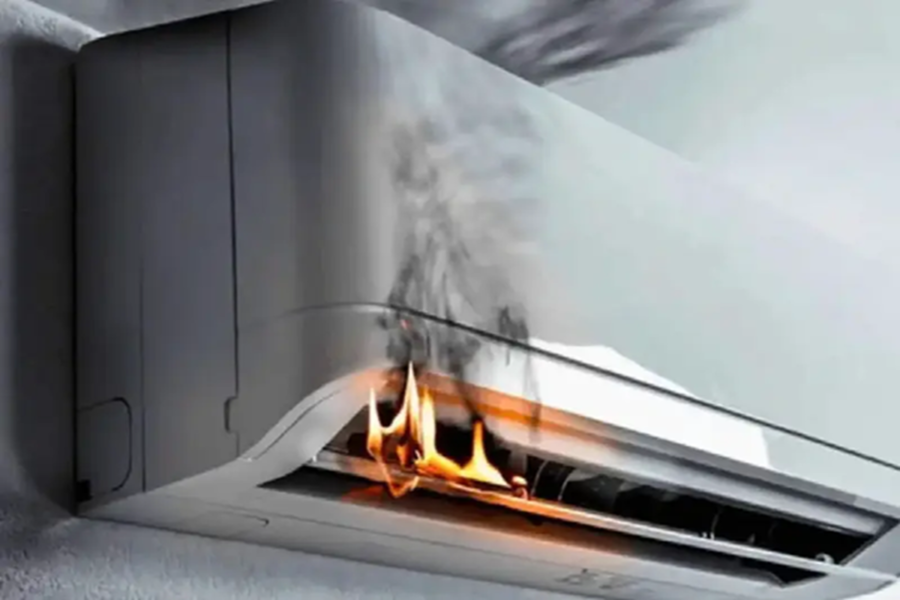
Recent incidents involving fires caused by air conditioners—first in Delhi's Vivek Vihar and subsequently in Greater Noida—have been a major topic of discussion. This raises the question: how and for what reasons do household appliances turn dangerous, and what is the correct way to maintain them to prevent such accidents? As temperatures rise in the coming days, the use of such appliances—and consequently, electricity consumption—is bound to increase naturally due to the heat and heatwaves.
Undoubtedly, an air-conditioned room is the safest haven during scorching heat; however, it remains safe only as long as you maintain it properly. Even the slightest negligence regarding household appliances can escalate into a major tragedy.
In Delhi, a fire broke out due to a short circuit in an AC unit, resulting in the deaths of nine people. Every year, reports surface regarding AC units catching fire or exploding. With just a little vigilance, such incidents can be easily averted. In most cases, technical issues are the primary culprits. Significantly, these incidents do not occur out of the blue; rather, they manifest as sudden accidents stemming from underlying problems that have persisted over a long period.
**Signs of a Malfunctioning AC**
**Electrical Issues:** The AC may begin to trip due to frayed wiring, loose connections, or aging electrical components. Continuously ignoring these issues leads to an increased electrical load, and voltage fluctuations can trigger sparks.
**Overheating:** While you can run an AC continuously for several hours, this does not imply that it can be used without restraint. Running the AC continuously without giving it a break places excessive strain on the compressor and internal wiring. It is precisely these factors that lead to accidents such as the AC exploding.
**Condenser Coils and Filters:** If you reside in an area prone to dust and smoke, you may frequently face issues with dust accumulating in the AC's coils and filters. When the filter becomes clogged, it obstructs the airflow and the dissipation of heat. This increases the pressure on the AC unit, causing it to overheat and potentially leading to an accident.
**Refrigerant Leakage:** If your AC is failing to cool effectively, there may be a leak in the refrigerant system. A refrigerant leak can cause the compressor's temperature to rise excessively. If even a small spark comes into contact with the leaking refrigerant gas, it can quickly escalate into a massive fire.
**Inadequate Maintenance:** Whenever an issue arises with an AC unit, repairs should *always* be performed by a trained technician. Furthermore, if the quality of the AC's internal components is substandard, it can lead to increased internal pressure within the unit, significantly raising the risk of an explosion.
**What Are the Warning Signs of a Fire Hazard?**
**Hot Air from the AC:** If the AC is blowing warm air, it indicates that the machine has overheated or is experiencing a serious technical malfunction.
**Sparks:** If you observe sparks or flickering lights when switching on the AC, it may be caused by a short circuit or a wiring issue.
**Burning Odor:** If you detect a burning smell emanating from the AC unit or its immediate vicinity, it is likely due to overheating or a technical fault.
**Unusual Noises:** Strange or distinct noises coming from the AC when it is switched on are a clear indication of an electrical or mechanical malfunction.
**Emitting Smoke:** Smoke coming from the AC is the most critical warning sign. In such a situation, the AC must be switched off immediately and inspected by a technician.
**Frequent On/Off Cycling:** If the AC repeatedly switches itself on and off, it may be due to overheating or a malfunction in its operational system.
**What to Do If Your AC Malfunctions?**
Always prioritize safety above all else.
Do not ignore *any* signs of a malfunction.
Immediately switch off the AC unit and unplug it from the power source.
Ensure the unit is thoroughly inspected by a technician before attempting to use it again.
**Essential Safety Measures to Prevent Hazards**
**Keep Filters Clean:** The AC's air filters should always be kept clean. Neglecting this not only compromises cooling efficiency but also significantly increases the risk of the AC unit overheating. Ventilation Considerations: Ensure that there is proper airflow to and from the AC's outdoor unit. Install it in an open space where heat can dissipate easily.
**Get Servicing Done:** The easiest and most effective way to ensure safety is through regular servicing. Before and during the summer season, it is essential to have a qualified professional inspect for—and rectify—issues such as gas leaks, faulty components, or defective wiring.
**Voltage Stabilizer:** This device helps regulate the power supply and protects the AC unit from sudden voltage fluctuations.
**Avoid Non-Stop Usage:** Instead of running the AC continuously, switch it off for a short while every few hours or utilize the timer function. This also helps extend the lifespan of the AC unit.
**What is the Correct Way to Use an AC?**
Clean the AC filters every 2–3 weeks.
Instead of operating the AC at very low temperatures (such as 16–18°C), set it to a range of 24–26°C. This will also result in energy savings.
Keep the room well-sealed. If cool air is allowed to escape, the air conditioner will have to work harder to maintain the desired temperature.
Protect the outdoor unit from dust and direct sunlight, as it is a critical component of the entire system.
A well-maintained air conditioner typically lasts for 10 to 15 years. As the machine ages, its efficiency declines, and the likelihood of malfunctions increases. If problems begin to arise, you should consider purchasing a new air conditioner.
