
AC Buying Tips: Understand This Difference Before Buying a New AC—Single Inverter vs. Dual Inverter: Which One Saves More Electricity?
Best AC Technology: Amidst the scorching heat of June, there has been a noticeable surge in the demand for air conditioners. However, when you set out to purchase an AC, you are typically presented with two options: Single Inverter and Dual Inverter. People often mistakenly assume—due to a lack of awareness—that the more expensive model is inherently superior. While both technologies claim to save electricity and deliver superior cooling, their underlying operational mechanisms differ significantly.
How Does a Single Inverter AC Work?
A single-inverter AC features a compressor motor that continuously adjusts its speed in response to the room's temperature. Once the room reaches the desired temperature—that is, once it has cooled down sufficiently—the compressor's speed decreases. Subsequently, the speed increases again whenever cooling is required.
In terms of technical advantages, this type of AC does not cycle on and off repeatedly. This results in lower electricity consumption and helps maintain a stable room temperature. For this very reason, single-inverter ACs are considered more energy-efficient compared to traditional non-inverter ACs.
Why is a Dual Inverter AC Considered More Advanced?
In contrast, a Dual Inverter AC utilizes a compressor equipped with a dual mechanism or a dual rotary system. This technology effectively balances the load placed on the compressor, allowing the unit to operate much more smoothly.
The primary benefit of this design is that the AC can cool the room more rapidly and maintain a stable temperature for extended periods. This difference is particularly noticeable at night, as temperature fluctuations are minimized, ensuring a consistently comfortable environment throughout the night.
Which One Saves More Electricity?
When it comes to energy conservation, the Dual Inverter AC is generally considered to be slightly more efficient. Its compressor is capable of operating effectively even at extremely low speeds, thereby reducing electricity consumption.
If the AC in your home runs for several hours daily—or even throughout the entire night—a Dual Inverter AC can prove to be a valuable investment, helping to significantly reduce your electricity bills over the long term. On the other hand, for those with limited usage—where the AC runs for only a few hours—a single inverter AC can also be a good and economical option.
**What is the difference in terms of cooling and noise?**
One of the greatest strengths of a dual inverter AC is its quiet operation. Its compressor and outdoor unit generate minimal vibration, resulting in reduced noise levels.
Furthermore, it is capable of delivering rapid cooling. Conversely, while a single inverter AC also provides effective cooling, it cannot match the smooth and silent performance offered by a dual inverter unit.
**Which AC is right for you?**
If you have a slightly higher budget and use your AC regularly for extended periods, a dual inverter AC could prove to be the superior choice. Its enhanced energy efficiency, lower noise levels, and faster cooling make it a beneficial investment for the long term.
Conversely, if you have a limited budget and your AC usage is restricted to shorter durations, a single-inverter AC can adequately fulfill your requirements.
**Do not base your decision solely on the inverter technology**
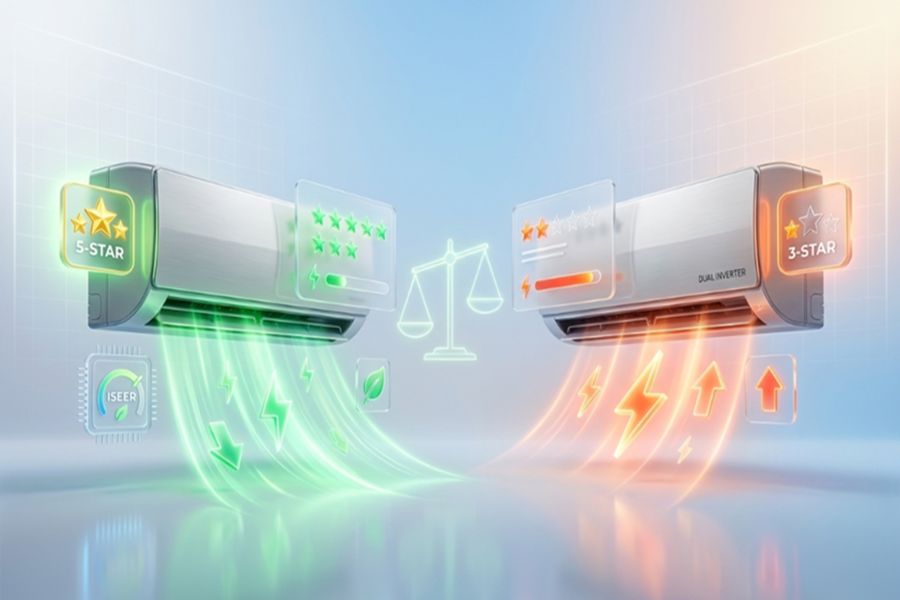
When purchasing an AC, do not base your decision solely on the presence of single or dual-inverter technology. It is equally important to consider factors such as the BEE star rating and the ISEER score.
In many instances, a single inverter AC with a higher star rating can actually save more electricity than a dual inverter model with a lower rating. Therefore, be sure to compare all these aspects before making your purchase.
Disclaimer: This content has been sourced and edited from TV9. While we have made modifications for clarity and presentation, the original content belongs to its respective authors and website. We do not claim ownership of the content.
