
A Scientific Marvel! Now, Bee-like Drones Can Navigate on Their Own—A Technology That Could Transform the World
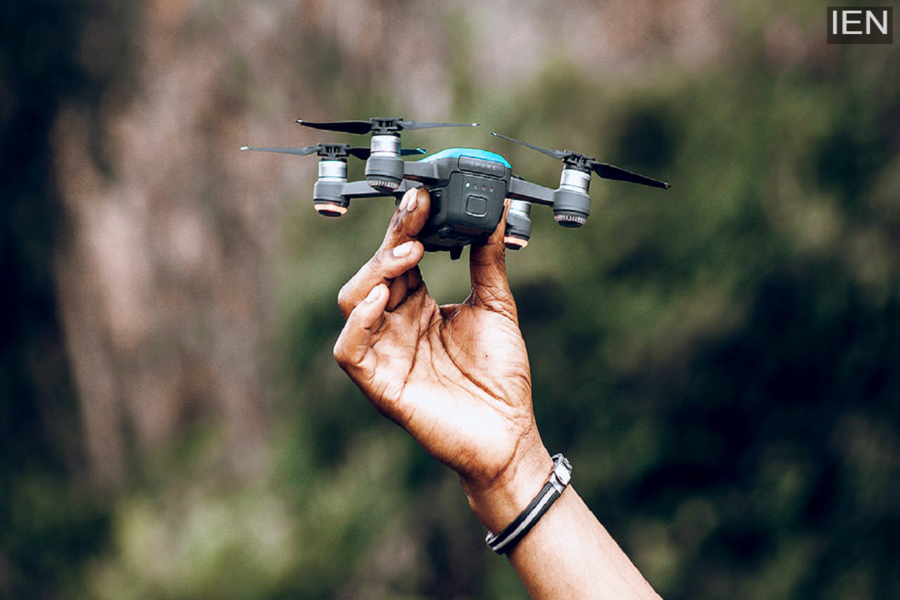
Mini Drones: This research was conducted collaboratively by scientists in Europe. The study highlights that honeybees, despite possessing tiny brains, are able to fly over vast distances and easily find their way back to their hives.
Mini Drones: Drone technology is advancing rapidly across the globe; however, the greatest challenge remains how small drones can accurately navigate without relying on bulky, heavy systems. Now, scientists in Europe have found a solution to this problem by drawing inspiration from nature. Researchers have developed a novel technology inspired by the way honeybees remember their routes. With the aid of this technology, even extremely small drones will be able to cover long distances using minimal memory and energy.
An Idea Inspired by the Bee’s Brain
This research was a collaborative effort among European scientists. The study notes that honeybees, despite the diminutive size of their brains, are capable of flying far afield and effortlessly returning to their hives. By deciphering this remarkable ability, the scientists developed a new navigation technology dubbed “Bee-Nav.” The objective of this system is to create small robots and drones capable of identifying their own routes autonomously, without the need for large onboard computers or extensive digital maps.
How Does the Bee-Nav System Work?
This technology functions in a manner remarkably similar to that of young honeybees. When the drone takes flight for the first time, it captures images of its immediate surroundings. Subsequently, a compact neural network processes these images to learn how to find its way back “home”—that is, to its original starting point.
To estimate distance and direction, the drone employs a technique known as odometry. This process is akin to how a human estimates distance while walking by counting their steps. However, relying solely on this method does not always guarantee accuracy; therefore, the drone also retains a memory of the visual cues within its environment.
The Entire System Operates on Minimal Memory
Perhaps the most astonishing revelation from this research is the incredibly low memory requirement of this technology. In certain test scenarios, the entire neural network was observed to function using a mere 3.4 kilobytes of memory. Even during extensive outdoor trials, the entire system operated using a mere 42 kilobytes of memory. By comparison, existing drone navigation systems demand many times that amount of storage and processing power. This is precisely why small drones often become bulky and expensive.
Drone Returns After Traveling 600 Meters
Scientists tested this technology in both indoor and outdoor environments. At a drone testing facility in the Netherlands, a drone was sent to a distance exceeding 600 meters and successfully returned to its starting point. However, the drone encountered difficulties in strong winds; the gusts disrupted its stability, making it challenging to accurately identify visual cues. Despite these challenges, the outdoor trials achieved a success rate of approximately 70 percent.
Potential for Major Applications in Agriculture and Greenhouses
Researchers believe that this technology could prove immensely valuable in the future for agriculture and greenhouse monitoring. Lightweight drones would be able to inspect crops and detect diseases or pests—all without posing any risk to human safety.
Nature Offers New Technological Solutions
This research has once again demonstrated that even the smallest creatures in nature can serve as a profound source of inspiration for modern technology. Scientists suggest that by studying bees, humans can develop smart technologies that are more cost-effective, lightweight, and efficient.
