
Why did Cambridge name 'human' the Word of the Year, and why is it being talked about?
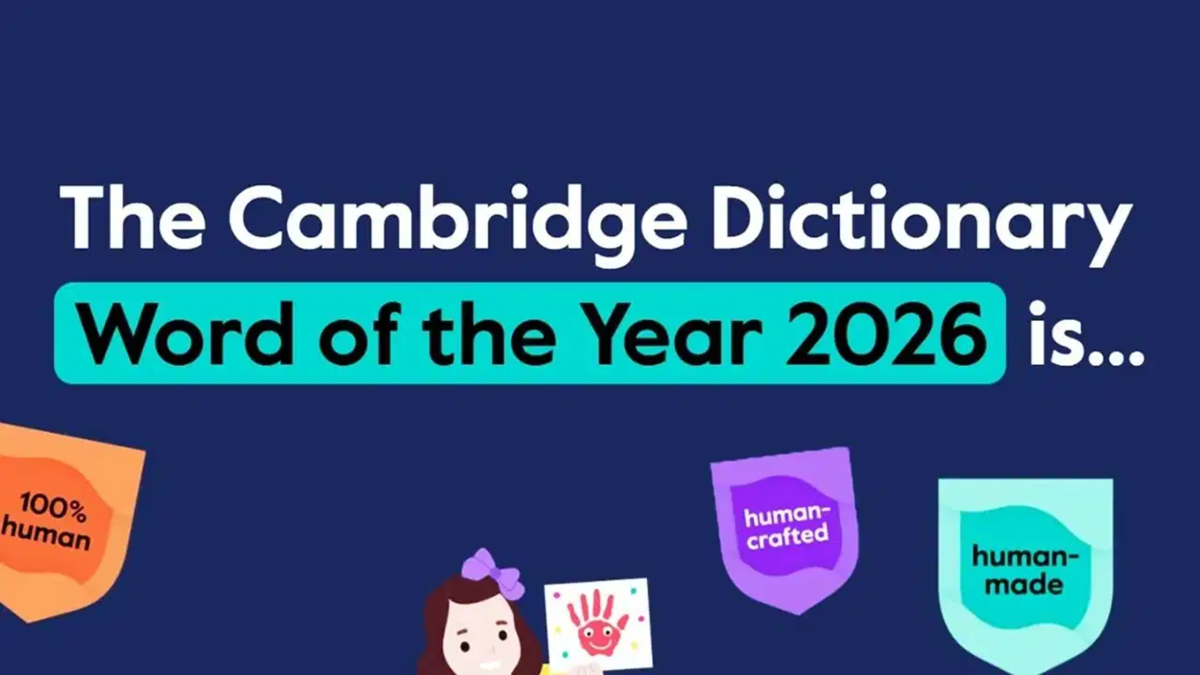
Cambridge Dictionary has announced its ‘Word of the Year 2026’: ‘human’. This selection has sparked global discussion, with many questioning the reasons behind Cambridge Dictionary’s choice. Other contenders for the title included ‘agent’, ‘wholesome’, and ‘analog’.
Let’s explore the full story and understand why Cambridge Dictionary selected ‘human’ as its ‘Word of the Year 2026’. We will also look at other terms that have been added to the dictionary.
Highlighting the relevance of ‘human’ in the age of AI
By naming ‘human’ as the ‘Word of the Year 2026’ during the rapid rise of AI, Cambridge Dictionary underscores the enduring relevance of the term. The selection prompts a reflection on what it truly means to be human at a time when AI is blurring the lines between humans and machines. Colin McIntosh, a lexicographer at Cambridge Dictionary, noted that the increasing use of AI has reignited interest in the distinctions between humans and machines. In this context, the selection of the word "human" as the "Word of the Year 2026" reflects this evolving discourse. Professor Rachel Adams, an expert in AI governance and human rights at the University of Cambridge, noted that AI is bringing fundamental questions regarding human identity back to the forefront.
According to the dictionary, the qualities, flaws, and emotions inherent to being "human" are what distinguish humans from deities, animals, or machines.
**New terms added to the dictionary**
The Cambridge Dictionary has added several terms that gained popularity in 2026, including "aura farming," "looksmaxxing," and "air-gelding." "Air-gelding" refers to a method of keeping an animal off the ground to curb unwanted behavior. "Aura farming" denotes the cultivation of an impressive persona that garners admiration from others, while "looksmaxxing" refers to the effort to make oneself as physically attractive as possible.
**Potential future additions**
The Cambridge Dictionary may also include three other terms in the future: "weather whiplash," "FOBO," and "dusking." "Weather whiplash" describes sudden, extreme shifts in weather conditions, while "FOBO" (Fear of Being Obsolete) refers to the fear of becoming redundant due to AI. "Dusking" refers to the practice of observing the transition from daylight to darkness as a form of relaxation.
**Other contenders**
Other terms in the running for the Cambridge Dictionary’s "Word of the Year 2026" included "agent," "wholesome," and "analog." "Agent" refers to an AI system that operates autonomously, while "analog" pertains to activities that do not involve digital technology.
Disclaimer: This content has been sourced and edited from Money Control. While we have made modifications for clarity and presentation, the original content belongs to its respective authors and website. We do not claim ownership of the content.
