
What makes the number plates on Indian Armed Forces vehicles unique? Find out why they feature an arrow symbol..
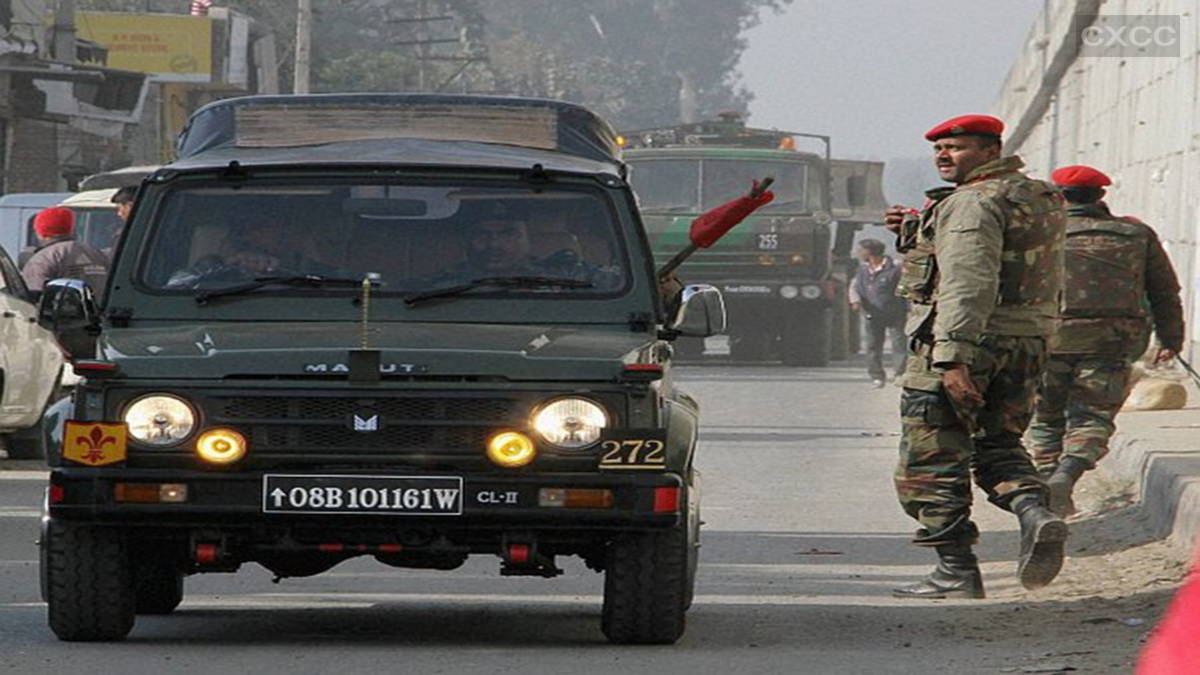
Indian Armed Forces Vehicle Number Plates: If you ever spot an Indian Armed Forces vehicle on the road, take a close look at its number plate. Army trucks, patrol vehicles, or cars belonging to senior military officers feature number plates that look quite different from those on ordinary cars or bikes. The white digits on a black background, along with an upward-pointing arrow at the top, often raise questions about their meaning. In reality, Indian Armed Forces vehicles follow a special registration system distinct from the standard RTO registration. A unique numbering format featuring a "Broad Arrow" is used to identify these vehicles. Let us explore this in greater detail.
Who issues number plates for Army vehicles?
While ordinary citizens register their cars or bikes with the relevant Regional Transport Office (RTO), the registration process for defense service vehicles is different. Vehicles belonging to the Indian Army, Navy, and Air Force are registered under a system managed by the Ministry of Defence. The Central Motor Vehicles Rules also provide for a separate registration mark for central government vehicles used for defense purposes.
This is why these vehicles do not display standard state codes like DL, UP, MH, or PB on their number plates. Instead, their registration numbers are part of a distinct system used nationwide to identify defense vehicles.
What is the arrow symbol on the number plate?
A distinctive feature in the identification of Army vehicles is the upward-pointing "Broad Arrow" symbol. Its origins trace back to the military system of the British era. The British Office of Ordnance used this mark to identify government and military property. Later, this tradition was adopted by the military systems of various British Commonwealth nations.
In India, too, the Broad Arrow was incorporated into defense vehicle number plates. It also serves a practical purpose: in the event of an accident or during a military operation, if the vehicle or number plate flips over, the arrow allows the correct orientation of the plate to be easily identified. This reduces the likelihood of the number being misread or misunderstood.
A number plate holds complete information about the vehicle.
It would be incorrect to view a defence vehicle's number plate merely as a registration number; its various components provide details regarding the vehicle's identity. A common format can be understood as follows:
↑ 21 B 123456 A
Here, every letter and digit carries specific meaning. While slight variations in the presentation of the format may appear across different official documents, the key components include the 'Broad Arrow', the vehicle's year, class code, serial number, and a check letter.
What do the two numbers following the arrow indicate?
The two digits following the 'Broad Arrow' usually represent the last two digits of the year in which the Defence Department procured the vehicle or inducted it into service. For instance, if '21' appears on the plate, it likely relates to the vehicle's procurement in 2021. Therefore, it is not always accurate to interpret this solely as the vehicle's year of manufacture.
The letter that follows indicates the vehicle's category or class. This is followed by a unique serial number used to identify that specific vehicle.
What do A, B, C, D, and X signify?
Different codes are used for various vehicle categories within the defence vehicle numbering system. For example, 'A' is used for motorized two-wheelers, and 'B' is used for Light Motor Vehicles (LMVs), such as cars.
Similarly, 'C' relates to vehicles like small trucks or pickups, whereas 'D' is used for trucks with a capacity exceeding three tonnes. 'E' may denote the category of high-mobility or multi-axle vehicles. Meanwhile, 'K' is used for ambulances, and 'X' designates active combat vehicles, such as tanks and armoured personnel carriers. In other words, if you see a year and then a letter following the 'Broad Arrow' on a military vehicle's license plate, that letter can indicate the vehicle's category.
Then, what is the purpose of the serial number?
The digits appearing after the vehicle category represent its unique serial number. This number is assigned to identify that specific vehicle. Additionally, there may be a letter—or a 'check letter'—at the end of the plate. This entire system aids in maintaining records and organizing the identification of army vehicles.
Discrepancies may be found in the lists of vehicle class codes and formats across various older defense documents. Therefore, it is incorrect to assume that every military vehicle's license plate follows the same format based on a single older example.
Are these vehicles restricted to a specific state?
That is one of the unique features of this system. Unlike standard private vehicles, defense vehicles do not follow a state-based registration system. They are registered under the defense establishment, allowing army vehicles to be used across different states and military installations.
Disclaimer: This content has been sourced and edited from News18 Hindi. While we have made modifications for clarity and presentation, the original content belongs to its respective authors and website. We do not claim ownership of the content.
