
What is the difference between the BSF, CRPF, ITBP, and the Indian Army? know here..
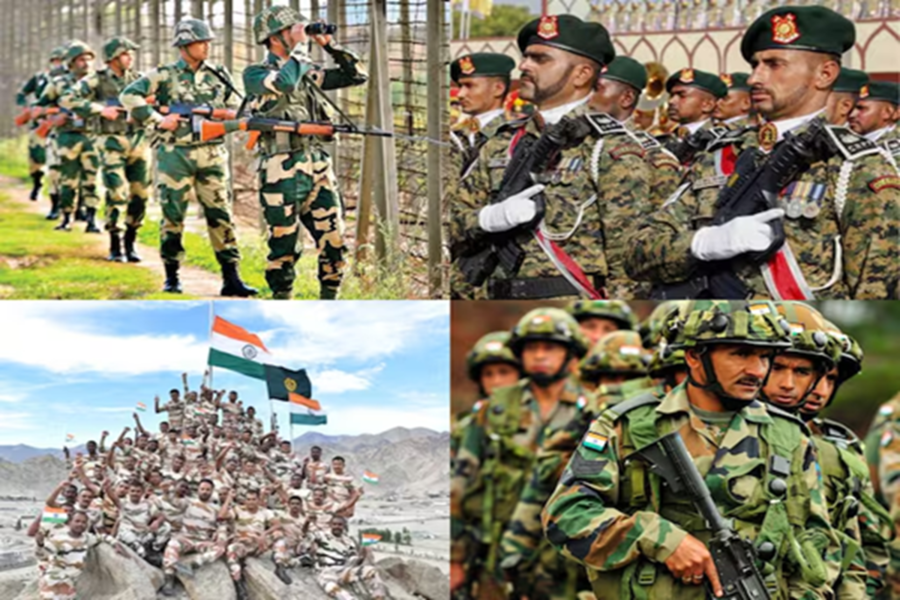
Difference Between BSF, CRPF, ITBP, and the Indian Army: Securing a large and diverse country like India is no easy task. The nation possesses extensive borders, and its internal challenges are equally significant. At times, threats emerge from hostile nations along the borders; at other times, internal issues such as terrorism, Naxalism, or civil unrest surface within the country. To effectively tackle these varied situations, India has established distinct security forces, each with clearly defined and specific responsibilities.
People often tend to conflate the Border Security Force (BSF), the Central Reserve Police Force (CRPF), the Indo-Tibetan Border Police (ITBP), and the Indian Army; however, in reality, their roles, operational methods, and responsibilities differ significantly. While the BSF and ITBP are tasked with securing the nation's borders, the CRPF is responsible for maintaining law and order within the country, whereas the Indian Army defends the nation against external adversaries.
Therefore, it is crucial to understand the distinctions between these forces—particularly for students and young individuals aspiring to build a career in the defense or police services. Let us now examine each force in detail to understand the specific ways in which they play a pivotal role in safeguarding the nation.
What are the Central Armed Police Forces (CAPF)?
Historically, forces such as the BSF, CRPF, ITBP, CISF, and SSB were referred to as 'Paramilitary Forces'; however, since 2011, they have been officially designated as the Central Armed Police Forces (CAPF). All these forces operate under the aegis of the Ministry of Home Affairs and are responsible for managing the country's internal security. These forces are typically led by IPS officers holding the rank of Director General. Their primary mandate revolves around policing and security-related functions, rather than exclusively military operations.
Border Security Force (BSF)
The Border Security Force was established in 1965. Its primary objective is to secure India's international borders—specifically the borders shared with Pakistan and Bangladesh. During peacetime, the BSF maintains constant vigilance along the borders, preventing infiltration, smuggling, and other illicit activities. During times of war, the BSF operates in close coordination with the Indian Army. A distinctive feature of the force is that it comprises a Water Wing (for riverine areas), an Air Wing (for aerial surveillance), and an Artillery Wing. BSF personnel guard the borders round the clock, enduring extremely arduous conditions.
**Central Reserve Police Force**
The Central Reserve Police Force (CRPF) was established in 1939 and stands as India's largest Central Armed Police Force. Its primary mandate is to maintain law and order within the country and to combat terrorism. The CRPF is frequently deployed in Naxal-affected regions, for election duties, during civil unrest, and in sensitive areas. It encompasses several specialized units, such as the RAF (for riot control) and COBRA (for anti-Naxal operations). Thousands of CRPF personnel remain deployed across the country on various missions.
**Indo-Tibetan Border Police**
The Indo-Tibetan Border Police (ITBP) was established in 1962, following the Sino-Indian War. Its primary responsibility is to secure the India-China border, which spans the extremely high-altitude and frigid terrains of the Himalayas. ITBP personnel remain steadfast in their duties amidst sub-zero temperatures, heavy snowfall, and treacherous mountainous conditions. Furthermore, the ITBP assists the public during disaster relief operations, such as floods, earthquakes, or avalanches. The force also possesses specialized expertise in mountaineering and survival training.
**Indian Army**
The Indian Army constitutes India's principal military force, charged with the responsibility of defending the nation against external threats. It operates under the aegis of the Ministry of Defence. The Indian Army is trained to conduct warfare, engage with adversaries, and safeguard the country's borders. Additionally, the Army undertakes relief and rescue operations during natural disasters—such as floods, earthquakes, and cyclones. The Army is led by the Chief of Army Staff (CoAS), while the President of India serves as its Supreme Commander.
Disclaimer: This content has been sourced and edited from News18 Hindi. While we have made modifications for clarity and presentation, the original content belongs to its respective authors and website. We do not claim ownership of the content.
