
National Education Day 2026: For a secure future in the age of AI, these skills are more important than a degree..
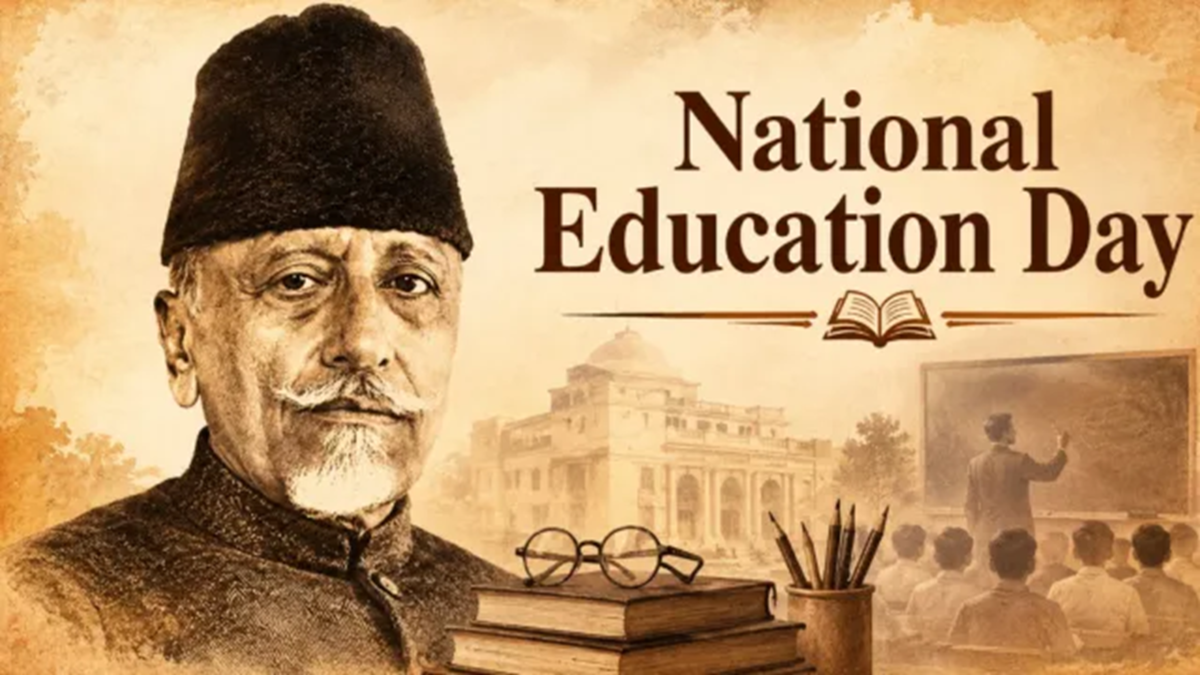
National Education Day 2026: In India, National Education Day is celebrated every year on November 11. This day, which marks the birth anniversary of India’s first Education Minister, Maulana Abul Kalam Azad, provides an opportunity to reflect on the importance of education and the state of the nation’s education system. A question often raised is whether our education system is truly preparing students for future challenges, or if it remains narrowly focused on examinations and degrees. The rapid rise of Artificial Intelligence (AI), evolving work cultures, and new professional expectations have challenged the traditional objectives of education. Today, merely obtaining a degree, securing high marks, or succeeding in examinations is no longer a guarantee of a secure future for students.
In an era where machines can rapidly analyze information and perform tasks once considered the exclusive domain of human intelligence, skills such as critical thinking, creativity, communication, and adaptability have become more essential than ever. Consequently, the purpose of education should not be limited to awarding degrees for employment; rather, it must focus on equipping students to thrive in a rapidly changing world.
The Importance of Human Intelligence in the Age of AI
Dr. Bhupendra Chaudhary—a philosopher, scientist (specializing in the science of consciousness), author, and speaker—argues that in the age of Artificial Intelligence, the goal of education should extend beyond merely imparting information or preparing students to excel in exams. As machines increasingly perform tasks with greater speed and precision, the value of human traits—such as independent thinking, self-awareness, and the capacity for sound, reasoned decision-making—becomes even more significant. Dr. Chaudhary states, “In the age of AI, machines are performing tasks—once considered the exclusive domain of human intelligence—with greater speed and accuracy. Consequently, the purpose of education should not merely be to excel in examinations or acquire information; rather, it should be to cultivate individuals capable of independent thought, self-awareness, and making prudent decisions amidst changing circumstances.”
In his research, he identifies consciousness as the foundation of human potential. To this end, he has introduced the concept of a ‘Consciousness Intelligence Quotient’ (CQ). According to him, the development of CQ will be just as vital in future education as the acquisition of knowledge and skills. This implies that, beyond providing information about the external world, students must be prepared to understand themselves, analyze their own thoughts, and make informed decisions.
The learning process should extend beyond the classroom.
Another significant challenge facing higher education is bridging the gap between academic knowledge and the professional sphere. According to Priyanka Behrani, Acting Dean of the School of Liberal Studies and Education at Navrachana University, while classroom knowledge forms the basis of a student’s development, the learning process should not conclude there. She remarks, “The classroom should serve as the starting point for learning, not its boundary. Academic knowledge provides a foundation, whereas practical experience empowers students to ask questions, conduct experiments, and devise solutions to problems.”
In her view, the success of higher education cannot be measured solely by examination results. It is equally important to assess how well-equipped students are to navigate the challenges of real life and the professional workplace. To achieve this, universities must maintain an ongoing dialogue with the industry and evolve their curricula to align with shifting professional demands.
Internships, live projects, and experiential learning can play a pivotal role in this regard. Priyanka Behrani emphasizes that, given the growing influence of AI, it is essential to foster not only technical proficiency but also critical thinking, creativity, effective communication, and adaptability. Universities should aim to produce not merely degree holders, but capable, inquisitive, and responsible citizens.
Evaluating competence beyond grades
The debate over the true purpose of education has intensified globally. According to Karan Lalit, Executive Director for South Asia at Educational Testing Service (ETS), in the age of AI, academic readiness can no longer be assessed solely by how much information students can memorize or the grades they achieve. He argues that what truly matters is how well students understand the information available to them, their ability to critically question ideas, their capacity to apply knowledge practically, and their skill in communicating their thoughts effectively.
Disclaimer: This content has been sourced and edited from News18 Hindi. While we have made modifications for clarity and presentation, the original content belongs to its respective authors and website. We do not claim ownership of the content.
