
JEE Advanced 2026: Aiming to secure a seat at an IIT? Experts share 'Golden Tips' to achieve a top score in JEE Advanced 2026..
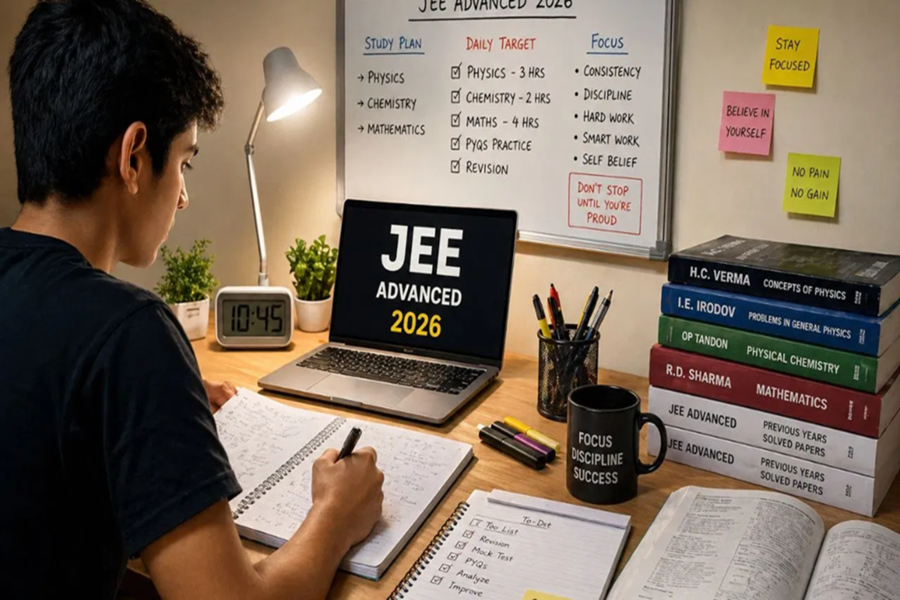
JEE Advanced 2026: The results and scores for the Joint Entrance Examination (JEE) Main have been released. Concurrently, the application process for JEE Advanced 2026 has commenced. The deadline to apply is May 2nd, while JEE Advanced 2026 is scheduled to be conducted on May 17th. This year, IIT Roorkee is organizing JEE Advanced. A total of 2.5 lakh students are participating in JEE Advanced 2026 to compete for admission to over 18,000 B.Tech seats across the country's 23 IITs. While it is the dream of all these students to secure admission to an IIT, a single minor error has often been enough to shatter such aspirations. With this in mind, Ramesh Batlish—a JEE expert from a private coaching institute—has offered some "golden tips." These tips could prove instrumental in helping students achieve a better score in JEE Advanced 2026, thereby helping them fulfill their dream of securing a seat in an IIT.
Let us explore the golden tips shared by Ramesh Batlish, the JEE expert from a private coaching institute, on how to achieve a better score in JEE Advanced 2026. Let's understand these tips in detail.
**The Path Becomes Easier with the Right Strategy and Regular Practice**
Ramesh Batlish, the JEE expert from a private coaching institute, noted that JEE Advanced 2026 is scheduled for May 17, 2026 (Sunday). Consequently, the preparations of the candidates have reached their final stages. He stated that although this is one of the most challenging entrance examinations, students can clear it with ease by adopting the right strategy and engaging in regular practice. While students may experience heightened levels of stress and pressure, their primary focus during the remaining time should be on utilizing it as effectively as possible.
**One or More Answers May Be Correct**
JEE expert Ramesh Batlish explained that the JEE Advanced question paper comprises a blend of various question types. It includes Multiple Choice Questions (MCQs), wherein there may be one or more correct answers. Additionally, some questions are based on reading passages (Comprehension), followed by two or more objective-type questions. In Matrix-Match type questions, students are required to match items across two or three columns.
In Integer-Type questions, the answer may be an integer or a value accurate up to two or three decimal places. Students must exercise caution, as these questions carry negative marking. A preparation strategy should incorporate effective time management and subject-wise planning. Furthermore, students should be mentally prepared to encounter potentially new types of questions in the examination paper.
**How to Utilize the Final Two Weeks Before the Exam**
JEE expert Ramesh Batlish states that the two weeks immediately preceding the JEE Advanced examination—that is, the final two weeks—are critical for any student. He emphasizes that an effective approach to utilizing this period is essential. To this end, he offers the following tips:
Create a revision plan encompassing all key chapters across Physics, Chemistry, and Mathematics.
Revise all important formulas and concepts.
Attempt a mock test every alternate day and focus specifically on time management.
To synchronize your biological clock, attempt mock tests during the actual scheduled time of the examination.
Study using your own handwritten notes.
Refrain from studying any new topics or referring to new textbooks during the final 1–2 weeks.
Analyze the results of every test you attempt.
Pay special attention to your health and well-being.
Maintain your focus and avoid unnecessary discussions.
Seek guidance from your teachers whenever necessary.
Practice meditation and yoga.
**Important Tips for JEE Advanced 2026 Preparation:**
JEE expert Ramesh Batlish has also provided several key tips specifically for those preparing for JEE Advanced 2026. Let us explore these in detail:
**Speed and Accuracy:** Practice solving as many questions as possible, and work through previous years' question papers. Both speed and accuracy are crucial.
**Study Material and Conceptual Clarity:** Solve questions of varying difficulty levels using a single, reliable set of study materials. Refrain from using a calculator. Cover the Entire Syllabus: Avoid selective studying and cover the complete syllabus.
Question-Solving Strategies:
Single Correct MCQ: Read the question and options carefully.
Multiple Correct MCQ: Analyze all the options.
Comprehension: Read the entire passage carefully.
Matrix Match: First, identify the distinct options.
Numerical: Attempt only when the concept is clear.
Assertion-Reason: Read both statements carefully.
Disclaimer: This content has been sourced and edited from TV9. While we have made modifications for clarity and presentation, the original content belongs to its respective authors and website. We do not claim ownership of the content.
