
How different is this exam from NEET and JEE? Everything from eyeglasses to shirt buttons is checked..
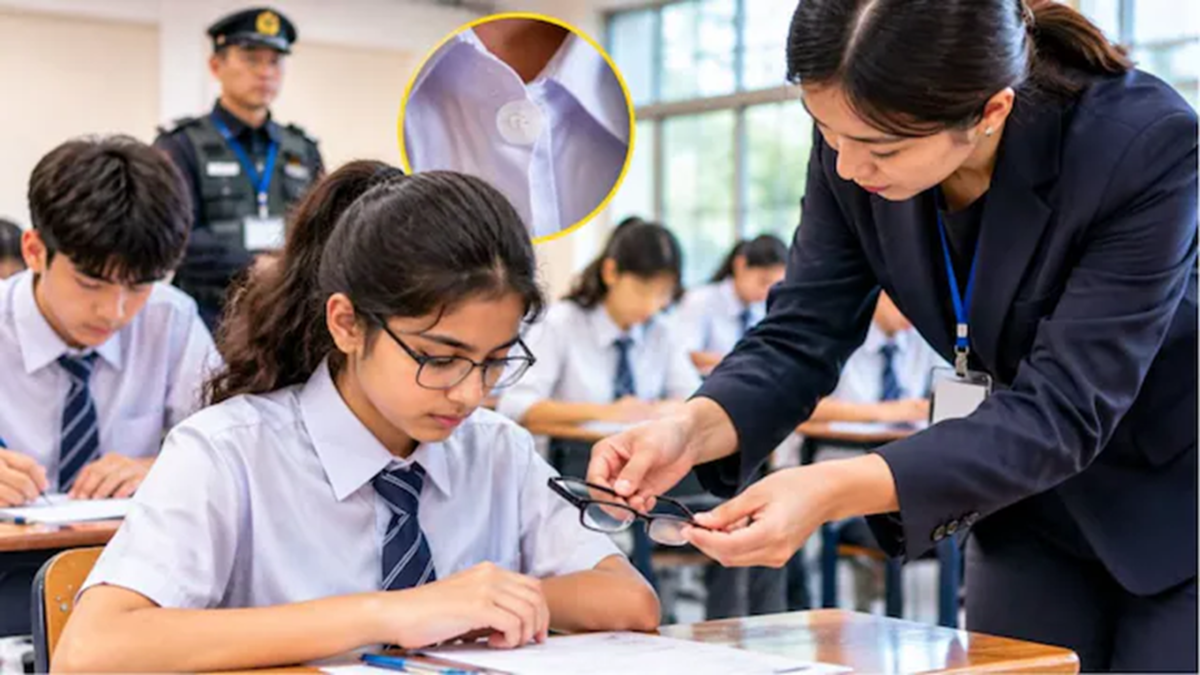
JEE/NEET Exams: Checking only admit cards and identity documents is no longer sufficient to prevent cheating in examinations. For its largest college entrance exam, South Korea has implemented stringent measures: candidates will have their eyeglasses, clothing, and even shirt buttons inspected. An additional 8,400 invigilators are being deployed at exam centers, and candidates caught cheating could face a ban from taking exams for up to 10 years. This heightened security follows an incident where a topper in a national tax accountant examination admitted to obtaining answers using hidden cameras, smartphones, and artificial intelligence (AI). This South Korean approach is highly relevant to India, where instances of cheating—involving electronic devices and other unfair means—have frequently surfaced during major entrance exams like NEET and JEE.
Eyeglasses must be removed for inspection; stickers to be placed on shirt buttons.
South Korea has introduced special anti-cheating measures for the ‘Suneung’ college entrance exam, scheduled for November 19. Also known as the College Scholastic Ability Test (CSAT), this exam will now require candidates wearing eyeglasses to place them on their desks before entering the examination hall. Invigilators will examine the frames to check for hidden cameras or other smart technology. Beyond eyeglasses, candidates' clothing will also be inspected—with particular attention paid to shirt sleeves, collars, and buttons—as officials fear that small cameras or recording devices could be concealed in these areas. Consequently, stickers will be applied to shirt buttons to prevent them from being used to hide recording devices. Candidates have been advised to avoid wearing clothing with buttons.
8,400 Additional Staff to be Deployed at Examination Centers
The South Korean government has significantly strengthened its surveillance system to prevent cheating during the examinations. According to a Reuters report, approximately 8,400 additional staff members will be deployed at examination centers. Of these, about 1,800 personnel will focus on detecting cheating involving smart devices and electronic equipment, while around 6,600 staff members will monitor the corridors outside the examination rooms and the surrounding areas. Candidates will not be permitted to bring smartphones, smartwatches, smart glasses, or any other devices equipped with cameras into the examination halls. Candidates suspected of concealing electronic devices may also be screened using metal detectors.
Over 550,000 Candidates to Appear for the 'Suneung' Examination
To understand the significance of this South Korean examination, one must consider the number of candidates and the country's educational landscape. More than 550,000 candidates are expected to take the 2026 'Suneung' (College Scholastic Ability Test) across approximately 1,300 examination centers nationwide. It is one of the most critical entrance examinations in South Korea, as it determines admission to universities. Since securing a spot at a prestigious institution can significantly influence future employment and career prospects, the government makes extensive arrangements every year to ensure the examination is conducted smoothly.
How Does the South Korean Examination Compare to NEET and JEE?
South Korea's 'Suneung' examination can be compared to entrance exams in India, such as NEET and JEE. In India, millions of students take these exams to gain admission into medical and engineering institutions. In terms of the number of candidates, these Indian examinations are quite large in scale. While over 550,000 candidates are expected to appear for South Korea's 'Suneung' in 2026, 1,999,895 candidates appeared for India's NEET-UG 2026. A total of 15,38,468 unique candidates appeared for the examination across both sessions of JEE Main 2026. This comparison clearly highlights the vast scale of major entrance examinations in India. Given this, measures such as monitoring at examination centers, prohibiting electronic devices, and taking strict action against instances of cheating become crucial.
PC Social Media
