
Explainer: Can Admission to School Be Denied Without Aadhaar? What Does the RTE Act Say?
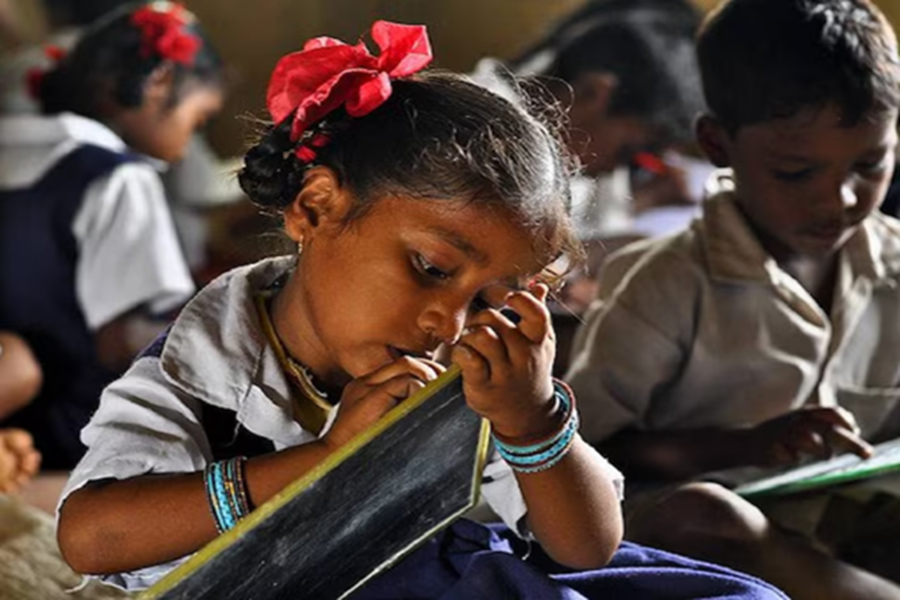
School Admission Without Aadhaar: Kalpana (name changed), a resident of Morna in Noida who hails from a village in eastern UP, arrived at a government school in Noida on April 1st. Kalpana herself is illiterate; when she took her two daughters—aged 8 and 5—to seek admission, she was asked to produce the children's Aadhaar cards. Lacking Aadhaar cards for her children, she pleaded for admission, but the school turned her away, stating that she must first obtain the Aadhaar cards before admission could be granted.
Kalpana’s case—returning without admission due to the lack of an Aadhaar card—is not an isolated incident; there are numerous such instances where even government schools have refused admission in the absence of an Aadhaar card or other proof of identity. Meanwhile, private schools often demand not only an Aadhaar card but even a birth certificate, refusing to grant admission without these documents. This situation compelled the Education Department of Haryana to issue a special circular mandating that admission be granted even without an Aadhaar card.
However, the most pressing question remains: Is this right? Is it truly impossible to secure school admission without an Aadhaar card or proof of identity? Does the Right to Education Act—which established education as a fundamental right in India—actually stipulate this? Why do different states have different rules regarding this matter? Let us investigate.
Did the Haryana Directorate of Education Have to Issue an Order?
For the new academic session, the Directorate of School Education in Haryana has issued a circular—under the "Pravesh Utsav" (Admission Festival) initiative—directing all schools across the state to admit children without making the production of a PPP (Parivar Pehchan Patra) or Aadhaar card mandatory. The circular explicitly states that children working at brick kilns or construction sites—or those belonging to migrant worker families—who do not possess an Aadhaar card or other identity documents must, under all circumstances, be granted admission to schools. Any violation of these directives will result in strict disciplinary action.
What Did the Supreme Court State in Its Order?
The dispute surrounding the requirement of Aadhaar cards for school admissions is not a new phenomenon. In this regard, the Supreme Court had also issued a specific order back in 2018. In an order dated September 26, 2018, a Constitutional Bench of the Supreme Court—led by Justice K.S. Puttaswamy—ruled that Aadhaar is not mandatory for school admissions.
**Where Does the Flaw Lie?**
Ashok Agarwal—a Delhi-based 'Social Jurist' and an advocate who has worked extensively to implement the 'Right to Education' on the ground—notes that the assertion that Aadhaar is mandatory for admission to government schools is a refrain heard not only in Uttar Pradesh but in schools across Delhi as well. However, when one visits the school in person, cites the relevant rules, and asserts the facts, they do proceed with the admission. While the country possesses the necessary laws, the system responsible for their implementation is dysfunctional. Why is a system not being established where children can simply come to school and study, free from any obstacles or impediments? One frequently encounters numerous instances where...
...schools frequently conjure up excuses to deny admission—claiming, for instance, that there is an error in the father's name, and therefore the child cannot be admitted. Or, they may refuse admission because a birth certificate is missing—even when the child is standing right before them. They demand proof for everything, insisting on documents to verify both address and age.
**Where is a child living on railway tracks or the streets supposed to procure such proof?**
Today, the quality of education in 80 to 85 percent of the country's private schools is not significantly better than that of government schools. The focus has shifted away from actual learning; instead, the business of schooling has come to revolve around showcasing new curricula, new uniforms, new textbooks every year, annual fee hikes, and highlighting various ancillary facilities rather than academic instruction.
It begs the question: how did schools unilaterally decide that Aadhaar is mandatory for admission? After all, this requirement has absolutely no bearing on the actual process of educating a child. While the mandatory requirement of Aadhaar makes sense when opening a bank account, why should it be a prerequisite for granting a child their fundamental right to education? This constitutes a systemic failure.
**What to Do If a School Refuses Admission**
Dr. Ashok advises that if a school fabricates excuses to deny admission, one can take legal action against it in a Civil Court or the High Court. Any parent can visit a school and firmly assert that the child *must* be admitted even without an Aadhaar card, as this constitutes a fundamental right of the child.
Disclaimer: This content has been sourced and edited from News18 Hindi. While we have made modifications for clarity and presentation, the original content belongs to its respective authors and website. We do not claim ownership of the content.
