
Education Budget 2026 Highlights: New Ayurveda AIIMS, Design School, and Big Push for Healthcare & Creative Education
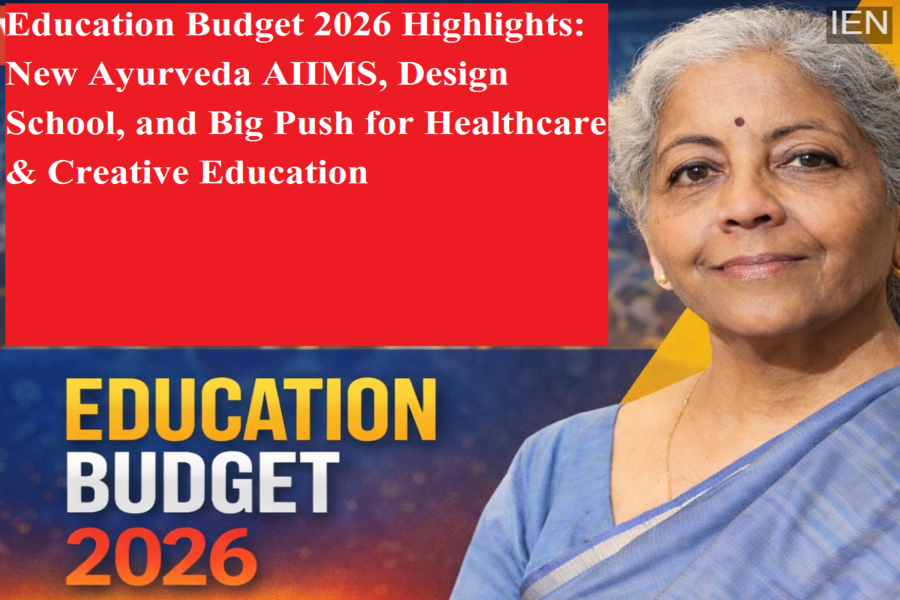
The Union Budget 2026–27 has outlined an ambitious roadmap for strengthening India’s education and healthcare-linked skill ecosystem. Finance Minister Nirmala Sitharaman announced a series of major initiatives focusing on traditional medicine, allied health education, creative learning, and industry-linked academic infrastructure. The government’s approach reflects a long-term vision to make education more employment-oriented while meeting rising global demand in healthcare, wellness, and creative industries.
A key highlight of the Education Budget 2026 is the proposal to establish three new All India Institutes of Ayurveda (AIIA), along with three additional Ayurveda institutions. These steps aim to expand research, training, and global outreach of India’s traditional medicine systems, which have gained international recognition, particularly after the COVID-19 pandemic.
Ayurveda and Traditional Medicine Get Global Push
While presenting the budget, the Finance Minister noted that Ayurveda has witnessed growing global acceptance in recent years. To meet this demand, the government plans to strengthen institutional capacity and ensure the availability of skilled professionals.
Apart from setting up new Ayurveda institutions, the budget also proposes upgrading AYUSH pharmacies and drug testing laboratories to international certification standards. This move is expected to improve quality assurance, boost exports of Ayurvedic products, and enhance global trust in India’s traditional healthcare systems.
Additionally, the World Health Organization’s Global Centre for Traditional Medicine in Jamnagar will be upgraded to support advanced research, training, and global collaboration in traditional medicine.
Expansion of Healthcare Education and Allied Health Courses
The government has announced plans to introduce 10 new allied health disciplines, including optometry, anesthesia technology, applied psychology, and behavioral health. Over the next five years, nearly one lakh allied health professionals (AHPs) will be trained to address the growing demand for skilled healthcare workers in India and abroad.
This initiative is aimed at strengthening India’s healthcare workforce while creating large-scale employment opportunities for youth in paramedical and support services.
Design and Creative Education in Focus
To promote innovation and creativity, Budget 2026 proposes the establishment of a new design institute in eastern India. The institute will focus on design thinking, innovation, and industry-relevant skills, helping students prepare for careers in emerging creative and design-driven sectors.
The budget also provides support to the Indian Institute of Creative Technologies (IICT), Mumbai. With government assistance, the institute will help set up content labs in 15,000 secondary schools across the country. These labs will enable students to gain exposure to digital content creation, media, design tools, and creative technologies from an early stage.
University Townships Near Industrial Hubs
In a major infrastructure push, the central government plans to support the development of five university townships near major industrial and logistics hubs. Each township will house multiple universities, colleges, research facilities, and residential complexes.
This model is designed to improve industry-academia collaboration, encourage applied research, and ensure that students acquire skills aligned with real-world industrial requirements.
Professional Education in Tier-2 and Tier-3 Cities
To expand professional education beyond metropolitan areas, the government will support professional bodies such as ICAI, ICSI, and ICMAI. These institutions will develop short-term modular courses and practical toolkits aimed at preparing “corporate-ready” professionals in Tier-2 and Tier-3 cities.
This initiative is expected to improve employability among youth in smaller towns while meeting the growing demand for skilled professionals in finance, compliance, and corporate services.
Boost to Medical Tourism
Recognising India’s potential as a global healthcare destination, Budget 2026 proposes the creation of five medical tourism hubs across different states. These hubs will integrate healthcare services, education, and tourism infrastructure, further strengthening India’s position in the global medical tourism market.
Looking Back: Education Budget Trends
In the previous financial year (2025–26), the education sector received a record allocation of ₹1.28 lakh crore. Of this, ₹78,572 crore was allocated for school education, while ₹50,077 crore went to higher education. The consistent increase in allocations over the years reflects the government’s sustained focus on education-led development.
Overall Impact
Education Budget 2026 signals a shift towards integrated learning models that combine healthcare, creativity, technology, and industry relevance. By investing in Ayurveda, allied health education, design institutions, and university townships, the government aims to prepare India’s youth for future-ready careers while strengthening India’s global leadership in traditional medicine and creative industries.
