
CCTV in Schools: Smart Classrooms and CCTV—Are We Putting Our Children in the 'Bigg Boss' House?
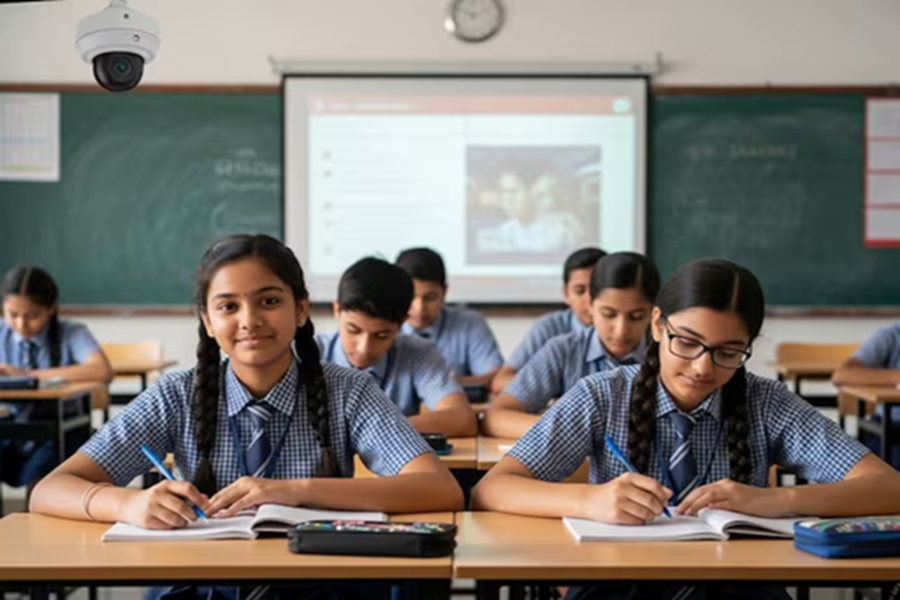
CCTV in School Classrooms: In the digital age, schools are no longer confined merely to "chalk and board." They have transformed into "smart classrooms," where tablets, interactive screens, and high-speed internet are integral components of the learning process. However, alongside this high-tech setup, another element that has firmly affixed itself to school walls is the CCTV camera. Today, it is rare to find a modern school that claims to be "smart" without an intricate network of cameras installed throughout its premises.
For parents, these cameras offer a sense of reassurance that their child is safe. While CCTV is widely regarded as a primary tool for security, its presence inside the classroom draws a fine line between safety and privacy. Will a child feel comfortable asking questions freely in a room where they know their every move is being recorded? Will teachers be able to express themselves without feeling under constant pressure? In the race to make smart classrooms even "smarter," are we inadvertently stripping children of that personal space where they learn and grow through trial and error?
Smart Classrooms and CCTV: The Great Tug-of-War Between Safety and Privacy
Nowadays, when enrolling a child in a school, parents evaluate not only the academic curriculum and track record but also the facilities and amenities provided. Smart classrooms equipped with CCTV cameras often rank as their top priority. Let us explore just how safe children truly are in such environments, and the impact this constant surveillance has on their privacy.
A Guarantee of Safety—or Just Fear?
The primary argument for installing CCTV cameras in schools is safety. Cameras prove highly effective in deterring external intrusions, preventing untoward incidents within the school campus, and curbing bullying. They are also deemed essential for safeguarding the expensive equipment and technology housed within smart classrooms. Parents often feel that the presence of cameras serves as a deterrent, keeping the behavior of school staff and other students in check.
Privacy and the Psychological Impact of "Surveillance"
Experts suggest that being under constant surveillance can lead to artificiality in a child's behavior. The classroom is, fundamentally, a space where a child should feel empowered to express themselves fearlessly. However, when a student is aware that someone is watching them ‘live’ or that they are being recorded, they fall victim to ‘self-censorship.’ Out of fear of making a mistake, they may stop asking questions, which hinders their learning process.
**Data Security Under Scrutiny**
Smart classrooms are connected to the internet. If CCTV footage is stored on the cloud or on online servers, there is a constant risk of it being hacked. The video recordings of children falling into the wrong hands could constitute a major security breach. Are schools adhering to strict cybersecurity protocols to safeguard this footage? This remains a significant question.
**Curbs on Teachers' Autonomy**
It is not just the students; teachers, too, feel the pressure caused by the presence of CCTV cameras in the classroom. Instead of employing creative teaching styles, teachers often find themselves preoccupied solely with adhering to rules and striving to appear ‘perfect.’ This carries the risk of diminishing the natural rapport between the teacher and the student.
**How to Keep Smart Classrooms Secure?**
While completely removing CCTV cameras may not be feasible, their usage must be governed by strict ‘ethical guidelines.’
Cameras should be positioned only in corridors or at entry gates, not inside the classrooms.
If a camera is present inside a classroom, the footage should be accessed only in emergencies.
Students and parents must be provided with comprehensive information regarding data security.
Disclaimer: This content has been sourced and edited from News18 Hindi. While we have made modifications for clarity and presentation, the original content belongs to its respective authors and website. We do not claim ownership of the content.
