
Career Tips: Understand the Real Difference Between Biotech and Microbiology..
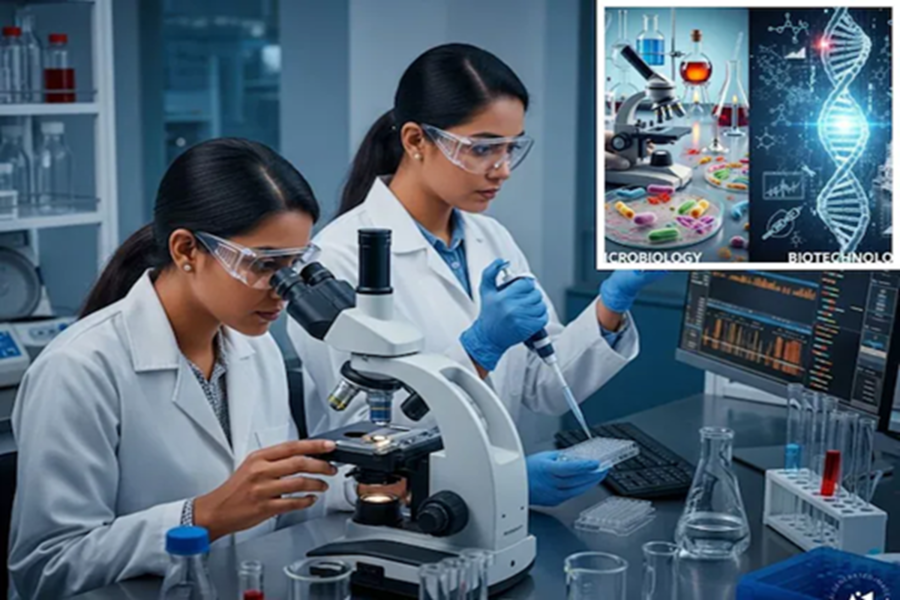
BSc Biotechnology vs. BSc Microbiology: When discussing modern science and medicine, two names frequently come to the fore: Biotechnology and Microbiology. After completing their 12th grade in the Science stream (specifically Biology), students often find themselves torn between these two career paths. While Microbiology focuses on organisms—such as bacteria, viruses, and fungi—that are invisible to the naked eye, Biotechnology utilizes that very knowledge to develop new products for human welfare, such as medicines and vaccines.
Both of these fields demonstrated their immense significance during the COVID-19 pandemic.
Microbiologists worked to understand the behavior of the virus, while Biotechnologists developed the corresponding vaccine. However, the crucial question remains: which course is the right fit for *you*? Would you prefer spending hours in a laboratory culturing microorganisms, or is your true passion rooted in genetic engineering and working with data? This choice depends not only on your personal interests but also has a profound impact on your future career prospects and earning potential.
What is the difference between a BSc in Biotechnology and a BSc in Microbiology?
If you have completed your 12th grade in the Science stream but do not wish to pursue a career in medicine (as a doctor), and instead wish to explore other career avenues within this broader field, you can certainly build a successful career in either Biotechnology or Microbiology. Read on to understand the key distinctions between the two.
What is the primary focus of each course?
Microbiology: This discipline centers on the study of microorganisms (microbes). The curriculum covers how these organisms grow, their impact on the environment, and the mechanisms by which they cause diseases.
Biotechnology: This is a 'multidisciplinary' field. It integrates the study of biology with principles of engineering and technology. Its primary objective is to utilize living systems to create useful products on an industrial scale. **Eligibility for Biotechnology and Microbiology**
For both courses, the minimum qualification required is completion of the 12th grade (with PCB/PCM subjects), with a mandatory requirement of securing at least 50% to 60% marks. For admission to some top-tier universities, candidates may be required to appear for entrance examinations such as CUET.
**Career Scope and Job Profiles**
**In Microbiology:** One can become a Clinical Researcher, Quality Control Officer, Food Microbiologist, or Medical Coder. There is a high demand for such professionals in the pharmaceutical, dairy, and brewing industries.
**In Biotechnology:** One can become a Genetic Engineer, Biomedical Engineer, Drug Developer, or Bioinformatician. There are significant opportunities available in companies focused on agriculture, healthcare, and environmental conservation.
**Salary Prospects**
At the entry level, a Microbiologist can expect an annual package ranging from ₹3 lakhs to ₹5 lakhs. In contrast, starting salaries in Biotechnology typically range between ₹4 lakhs and ₹6 lakhs. If you pursue a Master's degree (M.Sc.) or a Ph.D., this salary figure can rise to well over ₹10–15 lakhs per annum.
**Study Methodology in Biotechnology and Microbiology**
In Microbiology, a significant amount of time is spent in the laboratory working with 'Petri dishes' and 'microscopes.' Conversely, in Biotechnology, while lab work remains an integral part, greater emphasis is placed on bio-processing, computer modeling, and genetic manipulation.
Disclaimer: This content has been sourced and edited from News18 Hindi. While we have made modifications for clarity and presentation, the original content belongs to its respective authors and website. We do not claim ownership of the content.
