
B.Pharm Syllabus: Major changes to the B.Pharm curriculum after 12 years; students will also learn Python programming..
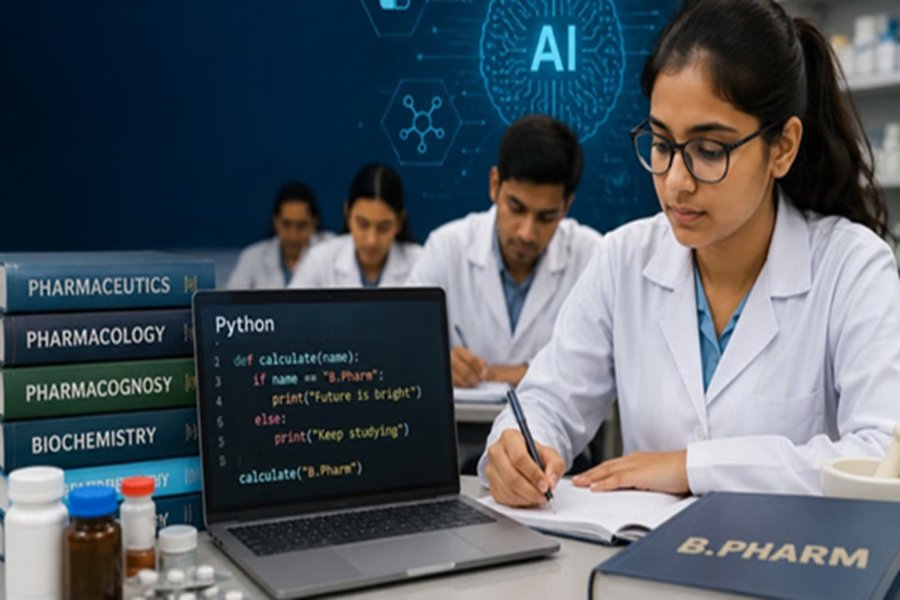
The Pharmacy Council of India (PCI) has introduced major changes to the B.Pharm curriculum after 12 years. The new curriculum prioritizes subjects such as Artificial Intelligence (AI), Machine Learning, Data Analytics, Digital Health, entrepreneurship, communication skills, and patient-centric care. Furthermore, if a student fails a semester, they will not be required to repeat the entire semester; they can continue their studies in the subsequent semester. However, they will still need to retake the examination for the failed semester.
PCI President Montu Bhai Patel shared this information during an exclusive conversation with *Amar Ujala*. He stated that, given the evolving healthcare sector, digital technologies, and industry requirements, textbook knowledge alone is insufficient. Pharmacists must now be equipped with scientific thinking, clinical understanding, and the capacity for technical innovation. The B.Pharm 2026 curriculum has been designed in alignment with the National Education Policy (NEP) 2020.
**Introduction of Digital Education from the First Semester**
Digital education has been integrated into the new syllabus starting from the very first semester. B.Pharm students will be taught the "Fundamentals of Python Programming for Pharmaceutical Sciences" in the first semester. The second semester will cover Applied Biostatistics and Data Analytics, while the third semester will introduce Machine Learning in Pharmaceutical Sciences. Subjects included in later semesters range from AI applications in pharmaceutical sciences (sixth semester) and AI in clinical applications (seventh semester) to the ethical aspects and practical applications of AI (eighth semester).
**Greater Choice for Students**
The new curriculum offers students the freedom to select subjects based on their preferences. Students will now be able to choose subjects aligned with their interests through Skill Enhancement Courses (SEC), Ability Enhancement Courses (AEC), and Value-Added Courses (VAC). These include subjects such as Green Chemistry, Medical Devices, Scientific Writing, Drug Store Management, Computer-Aided Drug Design, Professional Skills, Cleaning Validation, and Impurity Profiling.
Furthermore, under the new curriculum, students are required to undergo internships in two phases. A minimum of 240 hours of training has been made mandatory for the internship. Training can be undertaken in sectors such as pharmaceuticals, cosmetics, medical devices, the food industry, hospitals, and community pharmacies. Additionally, research projects will be mandatory in the seventh and eighth semesters, connecting students to research and innovation.
Other major changes include:
1. Under the new Choice-Based Credit System (CBCS), students must earn a minimum of 193 credits to obtain the B.Pharm degree. Credits are awarded for theory, practicals, internships, and projects.
2. The evaluation system within the syllabus has also been revised. Final results will now depend not only on the final examination but also on assignments, quizzes, group discussions, fieldwork, and sessional tests conducted throughout the semester.
3. A minimum attendance of 75 percent is mandatory for students. Additional marks will be awarded based on attendance, whereas no marks will be given if attendance falls below 75 percent.
4. Every pharmacy institute must organize at least one industrial or field visit for students annually. Additionally, institutes are required to adopt a village or ward to conduct activities such as community service, awareness campaigns on medication use, and patient counseling.
5. By including a subject on the "Innovation and Startup Ecosystem" in the new syllabus, students are encouraged to move towards innovation and entrepreneurship rather than simply becoming job seekers.
Disclaimer: This content has been sourced and edited from Amar Ujala. While we have made modifications for clarity and presentation, the original content belongs to its respective authors and website. We do not claim ownership of the content.
