
Armed Forces Career: From the NDA to the CDS—These Are the Major Pathways to Becoming an Officer in the Army..
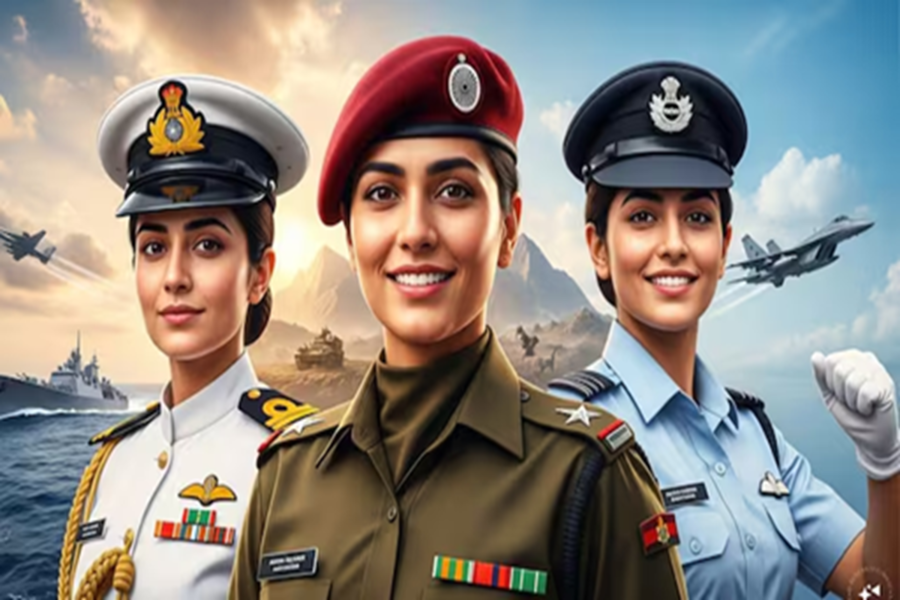
Indian Armed Forces: The Indian Armed Forces—comprising the Army, Navy, and Air Force—are not only the backbone of the nation's security but also offer the youth an opportunity to become part of one of the country's most prestigious and respected career paths. Joining the Armed Forces as an officer is not merely a job; it is a moment of immense pride. Every year, hundreds of thousands of young people prepare to join the forces, driven by this passion for national service; however, due to a lack of accurate and precise information, they often fail to select the appropriate entry scheme.
If you harbor a passion for serving the nation and aspire to see shining stars on your shoulders, this guide on 'Officer Entry in the Indian Armed Forces' will prove to be invaluable. The entry routes into the Indian Armed Forces are determined based on one's educational qualifications. One can apply for the officer cadre at two distinct stages: immediately after completing school (post-12th grade) or after completing one's graduation. Discover the primary pathways available for becoming an officer in the Armed Forces.
**Post-12th Grade: The NDA is the Most Popular Route**
If you have made up your mind to become an officer in the Armed Forces immediately upon completing your schooling, the National Defence Academy (NDA) is the finest avenue available. The Union Public Service Commission (UPSC) conducts this examination twice a year (NDA I and NDA II). Students who have passed the 12th grade—or those currently appearing for the examination—are eligible to apply (the age limit typically ranges between 16.5 and 19.5 years). Candidates who successfully clear the examination undergo three years of training at Khadakwasla, Pune, after which they proceed to their chosen service academy for further specialized training.
**Entry After Graduation: CDS and AFCAT**
For young individuals who wish to join the Armed Forces either during or after their college education, excellent opportunities also await. The UPSC conducts the Combined Defence Services (CDS) examination twice a year. Through this examination, candidates can secure entry into the Indian Military Academy (IMA), Officers Training Academy (OTA), Indian Naval Academy (INA), and Air Force Academy (AFA). Meanwhile, young individuals aspiring to become officers in the Flying or Ground Duty branches of the Indian Air Force can appear for the AFCAT (Air Force Common Admission Test) examination.
Entry Without a Written Exam: Direct SSB Entry
The Indian Armed Forces also offer certain schemes that do not require candidates to take a written examination. If you hold an engineering degree, you can apply directly through the TGC (Technical Graduate Course) or SSC Tech schemes. Additionally, a special NCC Entry Scheme is available for those who possess an NCC ‘C’ Certificate (with a minimum ‘B’ grade) obtained during their college years. In all these direct entry schemes, candidates are shortlisted directly for the SSB (Service Selection Board) interview based on their academic marks from college.
Excellent Opportunities for Women as Well
The era when the military was considered an exclusive domain for men has long since passed. Today, the doors to becoming an officer in the Indian Armed Forces are wide open for women as well. Women are now being commissioned as officers in the Army, Navy, and Air Force through various channels such as the NDA, CDS (via OTA), AFCAT, and various direct technical entry schemes. In several branches, women are now also being granted Permanent Commission (PC)—a development that presents a beautiful testament to women's empowerment.
The Most Crucial Stage of Selection: The SSB Interview
Whether you qualify through a written examination or enter via a direct entry scheme, every candidate must undergo a rigorous five-day SSB interview process. This evaluation is designed to assess a candidate's intelligence, personality, psychological resilience, and leadership potential (collectively known as Officer Like Qualities – OLQs). The process comprises group tasks, psychological tests, and a personal interview. Upon successfully clearing the SSB, candidates must pass a medical examination; subsequently, a final merit list is compiled, and the selected candidates are sent for training.
Disclaimer: This content has been sourced and edited from Amar Ujala. While we have made modifications for clarity and presentation, the original content belongs to its respective authors and website. We do not claim ownership of the content.
